- Opinion Opinion Opinion
- Architecture Architecture Architecture
News analysis
Isabelle Regnier
Architecture has taken center stage in the political debates of one of Europe's poorest nations. A broad social movement has, for months, denounced PM Edi Rama's corruption, after he launched several extravagant urban projects.
Published yesterday at 10:21 pm (Paris), updated at 7:44 am 3 min read Lire en français
Subscribers only
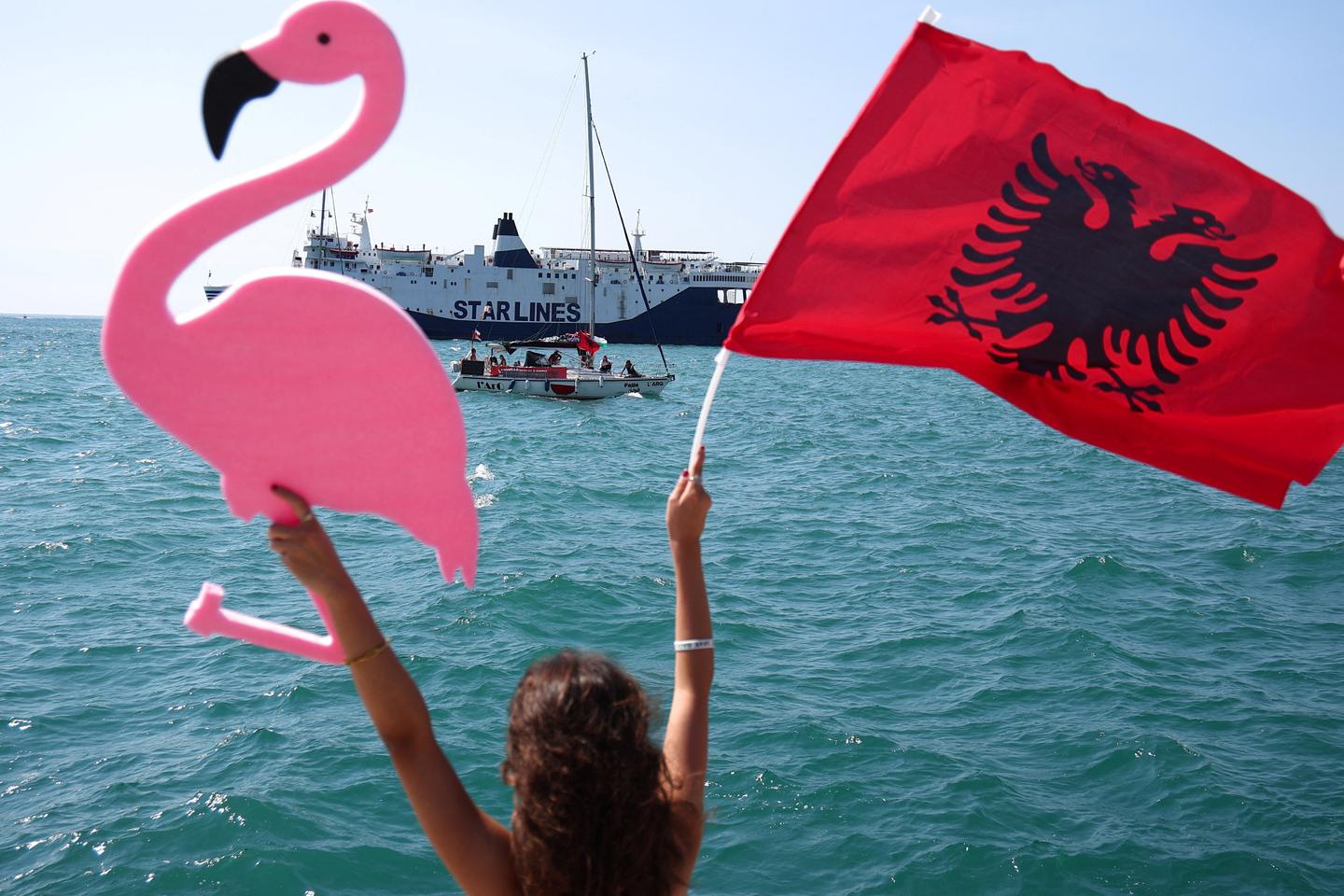
"Starchitect go home!" On June 3, surrounded by inflatable flamingos and placards marked with other slogans – "Albania is not for sale" and "Edi Rama resign!" – this Situationist-inspired slogan, spotted on a street in central Tirana, perfectly captured the unique political climate that has driven Albanians to take to the streets in protest every day for over three months. It is rare for architects to be singled out by a popular uprising. Yet in this country, which ranks among the poorest and most corrupt in Europe – Transparency International's Corruption Perceptions Index ranked Albania 91st out of 182 countries in 2025 – some of the most renowned architects have played a leading role in local politics.
Over the past two decades, they have competed to reshape Tirana, the capital city: With a tower sculpted like a face, a colorful pyramid, or a building that resembles an oversized Jenga tower. They were personally invited there by Prime Minister Edi Rama, who has banked on their fame and extravagant buildings to project an image of his country as a place that embraces a seductive vision of modernity. They have operated outside the European Union's regulatory framework, with no environmental or social constraints and no regard for local urban planning.
This "arch army," as Rama has dubbed them, has, in the past few years, also expanded its operations along the Adriatic and Ionian coasts. In May, a previously accessible stretch of coastline near the Municipality of Zvërnec had fences installed around it, alerting residents to what was playing out in their area: A luxury resort project spanning both the coast and neighboring Sazan Island, which, under a 2024 law, can now be converted into a tourist site, even though it houses a critical biodiversity reserve. The $5 billion (€4.3 billion) resort project is funded by Jared Kushner, Donald Trump's son-in-law, and his firm Affinity Partners, which is also behind a planned real estate project for Gaza.
You have 64.33% of this article left to read. The rest is for subscribers only.