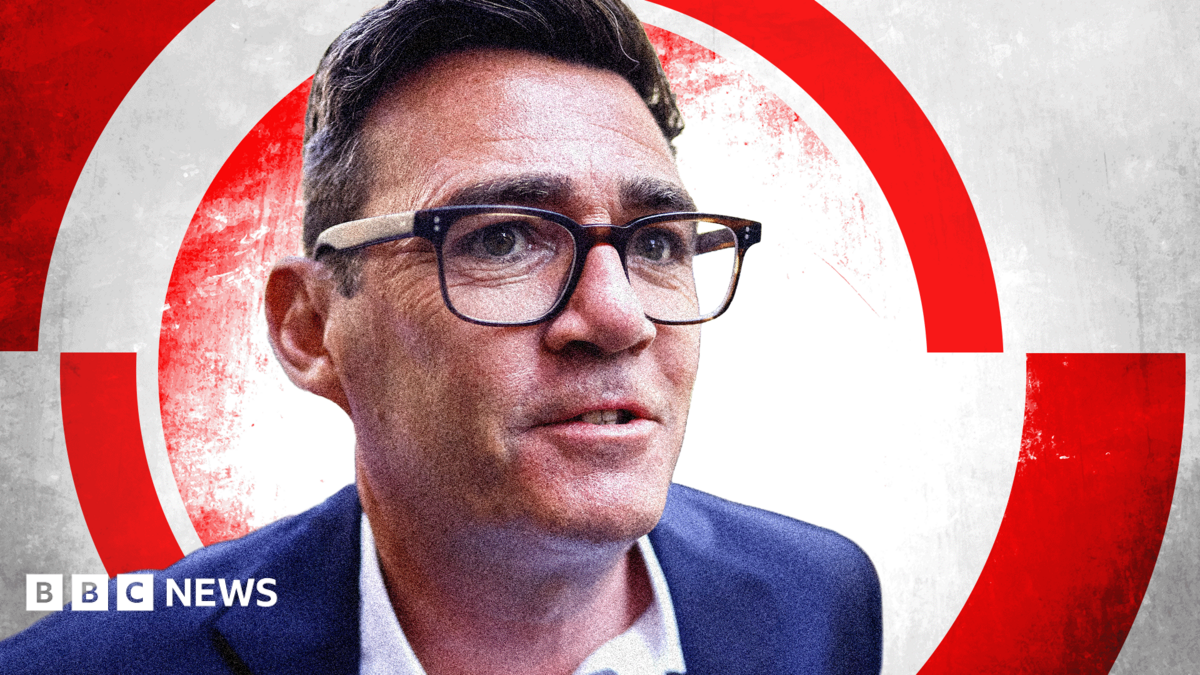
Burnham has said he would stick to Labour's pledge at the last election not to raise the main rates of income tax, VAT or National Insurance, whilst maintaining there is "some room within that manifesto for movement" in other areas.
During his campaign to be re-elected an MP, he also said he wanted to "have a proper look" at potentially raising the £12,570 starting threshold for income tax.
Burnham has previously argued the UK overtaxes work and undertaxes wealth, prompting speculation he could raise capital gains tax - paid on profits made when selling assets such as shares and property aside from a main home.
In one interview, external, Burnham did not rule out a wealth tax, suggesting his incoming government may have "to ask for a little more" tax at some point.
The Labour MP said he would take time to review the state of the public finances and wanted to focus on "bringing people together" rather than creating "new divisions".
He has previously suggested that both council tax and stamp duty, a tax paid by homebuyers, could be replaced with a new tax on the value of land - an idea he has been advocating since as far back as 2010.
Speaking to journalists shortly after becoming prime minister, Burnham said he would be "looking at" the tax-free personal allowance ahead of his first Budget in the autumn.
Currently, most people don't have to pay income tax on the first £12,750 they earn. However, successive governments have frozen that figure, meaning that as inflation pushes salaries up, people pay more tax.
The decision to freeze the personal allowance is often dubbed a stealth tax.
The Institute for Fiscal Studies has estimated that unfreezing the threshold could end up costing £8.5-9bn a year.
Burnham acknowledged that changing the threshold would be "difficult" adding that it was "not without significant consequences".
Burnham has long supported the idea that social care should become a more universal system.
He reiterated his commitment to social care shortly after arriving in No 10, telling journalists he did "not want to leave office" without reforming the system and that he was "ready to use some of my political capital" on the issue.
In a speech in 2023, he suggested this could be funded by replacing inheritance tax with a new "national care levy". He has suggested everyone would pay this new tax, whilst "obviously the wealthiest would pay the most".
The Health Foundation think tank estimated in 2024 that an NHS-style model of universal and comprehensive care could cost around £17bn in additional funding by 2035/36.
A cheaper option would be a Scottish-style system, with basic protection for everyone against some care costs, which would cost around £7bn by 2035/36 to replicate in England, according to the think tank.
During his Makerfield campaign, Burnham said he did not "resile" from his previous stance, but is yet to offer further details of how the idea would be implemented.
How to improve England's social care system, where subsidised care is currently reserved for those with the highest needs and fewest assets, is a question that has bedevilled politicians for years.
Labour promised to overhaul the system in opposition, but upon taking office commissioned a review of funding that is not due to report until 2028. Burnham has said he would bring that forward to the end of this year.
Burnham has said he would like the UK to rejoin the EU within his lifetime, but he has insisted he does not want to "re-run the [2016] referendum now".
He has pledged to seek a "closer relationship" with European countries, and "consolidate the progress made" on existing negotiations with the EU.
His stance on relations with the EU would soon be put to the test, as he inherits a series of live negotiations on youth visas, food regulations and plans to relink the UK to the EU's carbon pricing regime.
Defence spending, which prompted the resignation of Starmer's defence secretary John Healey earlier in June, would provide another headache.
In one of his final decisions in office, Sir Keir announced a plan to increase military spending by £15bn over the next four years by cutting spending in other parts of government, whilst leaving the details to Burnham to flesh out.
A key challenge would also be how Burnham seeks to handle US President Donald Trump. He has said the UK should seek a "good relationship" with the US, whilst being willing to say "if we can't agree with them".