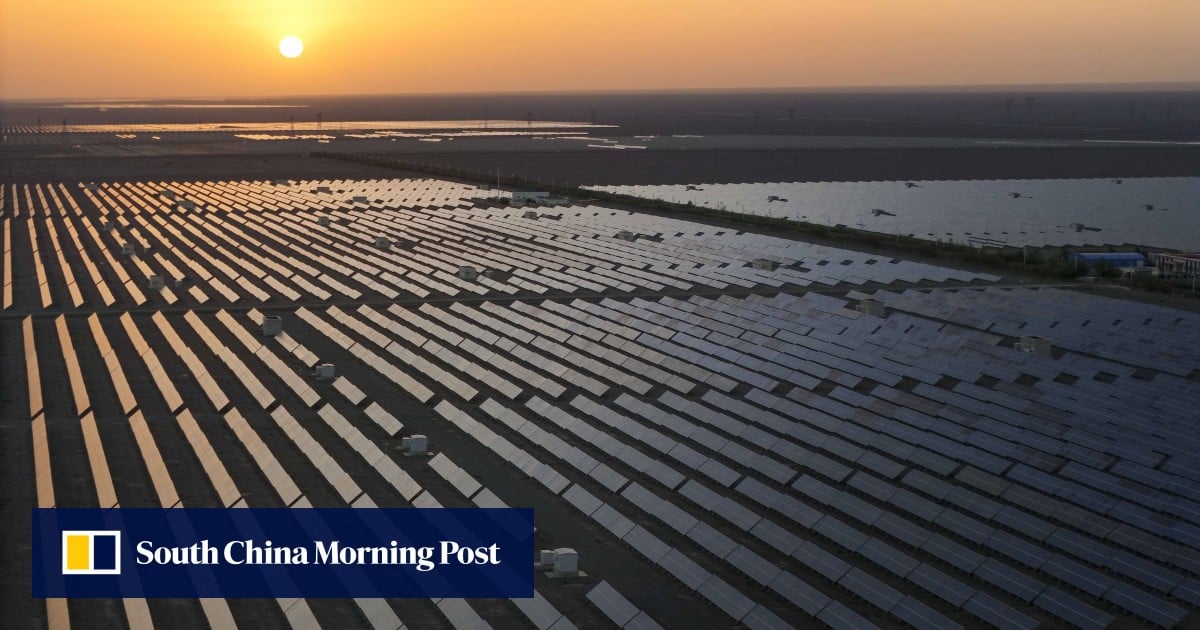
Following in the footprints of its ambitious Great Green Wall, China is leaning into a solar-powered pivot as part of its decades-long effort to tackle desertification in the arid north.
The expanding Great Solar Wall initiative, centred in the Inner Mongolia autonomous region, could help to power China’s economic hubs as the country accelerates its transition away from fossil fuels.
Transforming the desert into solar power hubs could generate clean energy while at the same time halting desertification and creating habitats that will allow plants and wildlife to thrive.
Solar is poised to overtake coal as China’s largest source of installed power capacity by the end of the year, with much of it under construction in its western and northern regions, including Inner Mongolia and the Xinjiang Uygur autonomous region, with their abundant sunshine and land.
In 2022, China’s National Development and Reform Commission issued a plan to build large-scale wind and solar projects in the arid regions – including the Gobi Desert – to reach an installed capacity of 455 gigawatts by 2030, according to Xinhua.
09:35
How is China building a great green wall to protect itself from desertification
This would be equivalent to the capacity of around 20 of China’s Three Gorges – the largest hydroelectric facility in the world – and more than seven times the planned Yarlung Tsangpo mega-dam project.