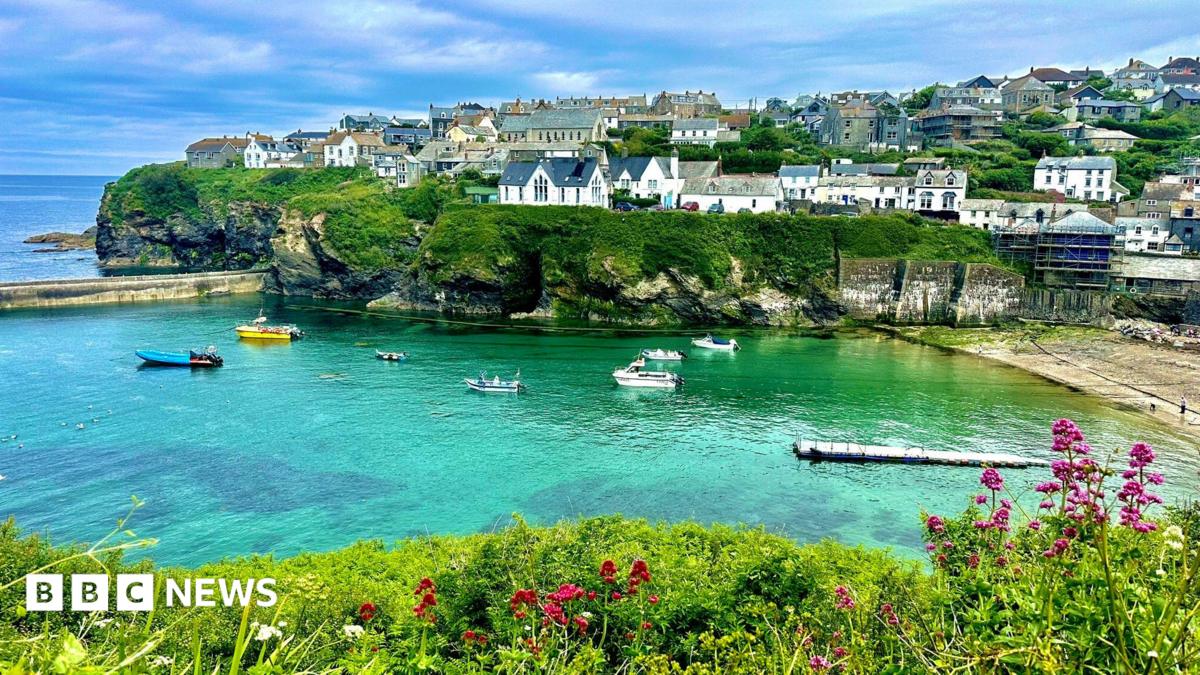
This year, millions of holidaymakers will head to Cornwall and Devon for their sandy beaches and pretty coastal towns - just two reasons why the South West peninsula is England's top tourist destination.
Yet behind its wild coastal beauty and affluent towns lies a different story: one of lost opportunities and the unfulfilled potential of many growing up in the region.
On almost every measure, the region is among the weakest educationally, according to the South West Social Mobility Commission, a coalition of organisations trying to bring about change.
Disparities in GCSE results are often framed through the lens of a North-South divide, but that narrative can obscure the challenges facing children in coastal and rural parts of England.
When you look at the regional data for English and maths GCSE passes for all pupils in England, you can see that, overall, the South outperforms the North.
Tanya Ovenden-Hope, Professor of Education at Plymouth Marjon University, describes what happens in the South West as "pretty poverty", and says this leads to fewer young people reaching their full potential.
She calls growing up in a low-income family in a coastal rural community a potentially "toxic" combination.
The government does measure the level of disadvantage in communities but Prof Ovenden-Hope says too much of that is done using measures that work for towns and cities, including transport.
"If you live in Cornwall you have to own a car. It's not a luxury, it's a necessity, because everything you do and everywhere you go involves some kind of travel. That's not measured by the government's measures of deprivation."
This matters because it helps decide how government money is allocated across England.
"It's not all ice creams and sandy beaches and turquoise seas," says Dominic Wilkes, a headteacher who moved from Greater Manchester to Bude in North Cornwall.
Higher housing costs and the need for a car impact training and teacher recruitment. While the remoteness of some communities can also act as a deterrent for young teachers to move here from other parts of England, according to recent research.
For Wilkes, who works at the only secondary school in Bude, the main upside is better teacher retention, which helps build a deep connection to the local community.
But inspiring children to think about different options for their future comes with its challenges.
As a teacher in Greater Manchester, Wilkes could hop on a tram to take pupils to museums and different workplaces, including the BBC at MediaCity in Salford, as part of the curriculum.
The nearest railway station is about 30 miles from Budehaven Community School. Pupils travel in from scattered villages and the area offers a relatively limited range of employers able to broaden their horizons or spark ambitions beyond the classroom.
Year 10 pupil Ethan, from Budehaven Community School, wants to become a marine biologist and recently completed a work experience placement at a seal sanctuary that was a three-hour round trip by car.
"I love being in the sea and just protecting its habitats and wildlife, it really makes me excited to do something like that," he said.
"I think Cornwall's amazing and all my family are here but I think I want to be able to grow as a person. I think I can only do that by leaving and exploring new adventures."
Year 9 student Burt told us he had to travel to Oxfordshire and Coventry to take part in the National Youth Choir, which meant his dad had to book a hotel to break up the journey.
He thinks there are good opportunities to be found but they're more difficult, and sometimes costly, to access from his town.
But others told us Cornwall is the perfect location for them. Poppy wants to be a florist and dreams of opening a seasonal business selling homegrown local wildflowers.
Wilkes has decided to spend above average on careers advice and trips, including to universities, to help expand pupils' horizons but it is still hard.
He had to turn down an offer of work experience from a "brilliant company" because although it didn't look too far on a map, it was five hours each way by road, without a direct bus service.
This kind of challenge potentially deepens the divide between families who have the money to afford petrol for long-distance trips or holidays abroad, and those who are just about managing the basics with a rising cost of living.
In the South West, much of the local employment is in farming or tourism, with young adults looking to leave and build their careers elsewhere.
In 2024, jobs related to the visitor economy made up approximately 20% of employment in Cornwall.
The South West Social Mobility Commission has other concerns about children who receive free school meals in the region.
It warns that 46% of secondary pupils (and 27% of primary pupils) are persistently absent, which means missing 10% of their school time.
While suspensions, exclusions and home education are also among the highest in England "raising important questions about school engagement, belonging and access to education".
In young adulthood, the potential impact can be seen in the proportion who go on to university, one of the biggest long-term drivers of improved earnings and life chances between generations.
In the South West, 19% of those who grew up receiving free school meals go on to get a degree, the lowest level in England, and below the North East. The national average is 29%.
This is what motivated Nick Wakeling, a teacher at Colyton Grammar School, to get in touch.
He runs the Colyton Foundation, a charity that supports young people into university.
One of the foundation's schemes is Your Future Story, backed by schools and universities to support 1,000 secondary school pupils from lower income families through touniversity with targeted support.
Libby is now considering a creative degree after Your Future Story arranged for her to go on a trip to Falmouth, a 1 hour 40 minute drive away. It "gave me an idea of what university would be like," she says.
There is a big push for locally generated solutions from the South West Social Mobility Commission, funded by a coalition including Exeter University, which warns the region is near the bottom on most measures of educational attainment from early childhood onwards.
While this can limit life chances in terms of getting to higher earnings, fewer young people in the South West are not in education, employment or training than most other parts of England. This is at a time when the national concern about what are called NEETs has reached an all-time high.
The report found the South West has the highest proportion of people who received free school meals as children in sustained work by the age of 28.
A Department for Education Spokesperson said: "This government believes every child should grow up with opportunity on their doorstep and hope for the future, with an education system that opens doors and cuts the link between background and success."
From this September, two pilot projects on raising education results in coastal areas are getting under way in Hastings and Scarborough in what the government is calling Mission Coastal.
The hope is to find approaches that transfer elsewhere, but the more rural and coastal South West may need to find quite different solutions.
Additional reporting by Isobel Cottam and Libby Rogers.