From
12h agoRomanian army carries out controlled explosion to divert water, help cool nuclear power plant
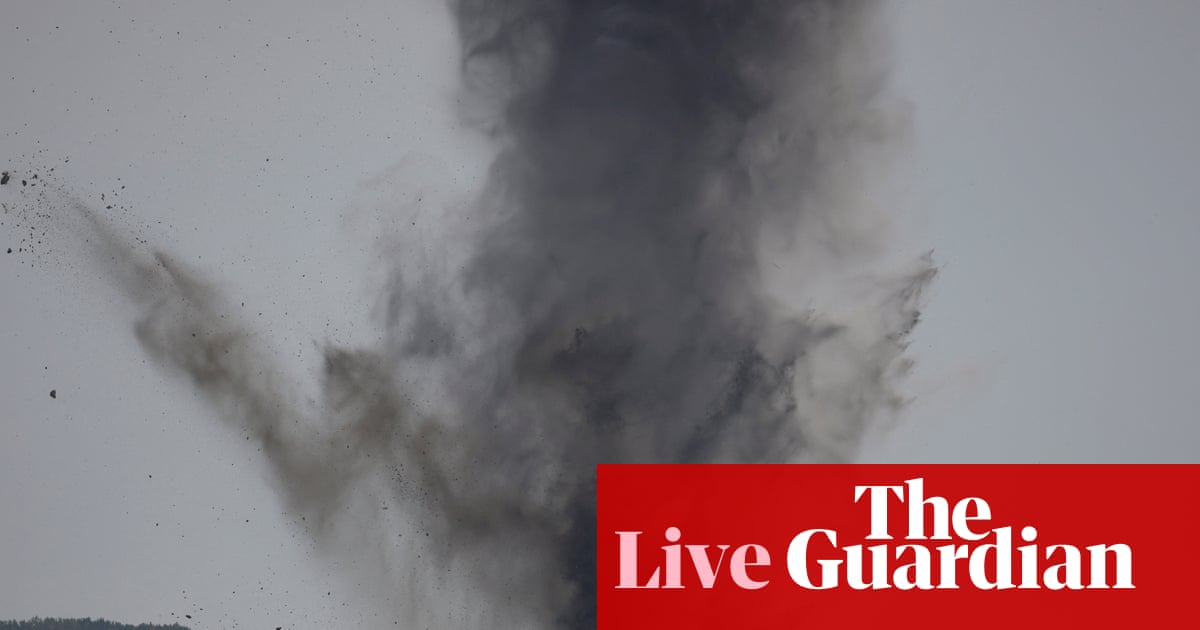
Meanwhile in Romania, the Romanian naval forces carried out a controlled explosion to divert a large volume of water to the Old Danube and the Cernavodă nuclear power plant to help with its cooling.
The Romanian Navy detonates underwater explosives during a controlled demolition of submerged rocks to improve water flow to the Cernavodă Nuclear Power Plant amid exceptionally low water levels on the Danube River, in Izvoarele, Romania. Photograph: Andreea Alexandru/APSome 180 kg of explosives were used today, Adevărul reported, to move a large rock restricting the flow of water.
Acting defence minister Radu Miruță hailed the operation as a success, saying it will help with cooling of the plant and water transport on the river.
Given the continuing extreme weather conditions, the Cernavodă plant may still have to temporarily suspend its operations at some point, but any extra day of its work is worth more than the cost of the explosion, he said.
Key events
6h ago
Closing summary
6h ago
Extreme temperatures, wildfires and droughts in Europe - in pictures
6h ago
Greece battling 'one of the worst' seasons of wildfires of the last decade, expert says
7h ago
Evacuees return home after France's largest wildfire on record
7h ago
Von der Leyen's letter on Ceuta seeks to show solidarity with Spain, but acknowledge frustrations of others - snap analysis
8h ago
Carmakers Dacia, Ford restrict production in Romania amid drought-related energy crunch
9h ago
EU needs to strengthen external borders, EU's von der Leyen tells Spain's Sánchez
9h ago
Italy's decision to reintroduce border controls with Spain published
9h ago
Hundreds of Greek firefighters continue to battle a wildfire northwest of Athens
12h ago
Romanian army carries out controlled explosion to divert water, help cool nuclear power plant
12h ago
Record low water levels affect transport of goods, energy security
12h ago
Two helicopters collide outside Athens as Greece battles to control wildfires
13h ago
Morning opening: South-eastern Europe braces for heatwave, energy crunch
Closing summary
Jakub Krupa
And, on that note, we will be closing the blog for today.
-
Romanian naval forces carried out a controlled explosion to help redirect vital cooling water from the drought-hit Danube to the country’s last working nuclear reactor (11:00).
-
Carmakers Dacia and Ford have temporarily suspended their production in Romania until 19 August as the country faces energy crunch as a result of drought limiting its power generation capabilities (14:48).
-
The explosion comes days after Romania declared a nationwide state of emergency on Friday, with the peak of the current heatwave expected later this week (12:05).
-
Neighbouring Hungary said it may be able to eke out two more days of power from its only atomic plant (9:46), but low levels of water in the Danube also affected other countries in the region (16:38).
Meanwhile,
-
Greece remained on high alert over wildfires amid growing concerns about “one of the worst fire crises” in recent history (16:27).
-
Thousands of evacuees were allowed to return home in France after a devastating wildfire in the western part of the country (16:06).
-
The European Commission president, Ursula von der Leyen, said that more must be done to strengthen the EU’s external borders, as she praised Spain and Morroco’s response to last week’s events in Ceuta, and said lessons must be drawn to avoid further escalations with growing questions over Morocco’s role in the crisis (13:25, 13:59, 15:43).
If you have any tips, comments or suggestions, email me at jakub.krupa@theguardian.com.
I am also on Bluesky at @jakubkrupa.bsky.social and on X at @jakubkrupa.
Extreme temperatures, wildfires and droughts in Europe - in pictures
A wildfire burns in Vlychada, west of Athens, Greece. Photograph: Louisa Gouliamaki/ReutersA firefighting helicopter drops water over a wildfire on Mount Kithairon near Porto Germeno, northwest of Athens, Greece. Photograph: Petros Giannakouris/APThe fire department is battling a very large fire in the De Rosmolen nature reserve in the Netherlands. Photograph: ANP/ShutterstockDrone view shows a boat at the port amid low water level of the Danube River in Batina, Croatia. Photograph: Antonio Bronić/ReutersStranded boats are seen on the muddy riverbed along the Danube River - Europe's second-longest river passing through 10 countries before emptying into the Black Sea in Novi Sad, Serbia. Photograph: Anadolu/Getty ImagesGreece battling 'one of the worst' seasons of wildfires of the last decade, expert says
As Greece grapples with a succession of massive wildfires, Theodore Giannaros, a senior wildfire meteorologist at the National Observatory told AFP on Monday the country faced “one of the worst fire crises” in recent memory.
Hundreds of firefighters have been battling multiple blazes across Greece, which have claimed five lives over the past two weeks.
“I would say that it is definitely one of the worst fire crises I’ve seen in the past, maybe eight to 10 years.”
Over the weekend, Giannaros said the fires around Porto Germeno, about 70 kilometres (45 miles) by road northwest of Athens in the region of Viotia, were likely to be classified as a megafire.
A man watches flames rising during a wildfire near Porto Germeno, northwest of Athens, Greece. Photograph: Michael Varaklas/APFrom the deadly Mati wildfire in 2018 to the massive Evros blaze in 2023, Greece endured a succession of destructive fire disasters between 2018 and 2025, cementing the eastern Mediterranean’s status as one of Europe’s most vulnerable regions to wildfires, AFP noted.
Evacuees return home after France's largest wildfire on record
Over in France, thousands of evacuees were allowed to return home and or to holiday accommodation after a massive wildfire remained contained, AP said.
A drone view of buildings destroyed by a wildfire in Le Porge, Gironde department, France. Photograph: Yves Herman/ReutersMore than 224,000 people had fled in what officials said was the country’s largest civilian evacuation outside wartime as the wildfire burned about 420 square kilometres (162 square miles), making it France’s largest wildfire on record.
Monday’s return includes Cap Ferret peninsula, a tourist hotspot along the Atlantic coast, and Le Porge, the municipality hardest hit by the fire, where 183 homes were destroyed, AP said.
Campsites remain closed.
Von der Leyen's letter on Ceuta seeks to show solidarity with Spain, but acknowledge frustrations of others - snap analysis
We now got our hands on a copy of von der Leyen’s letter to Spanish PM Pedro Sánchez.
Spain’s prime minister Pedro Sánchez and interior minister Fernando Grande Marlaska visit the Spanish city of Ceuta in North Africa last week, amid an ongoing migration crisis in the territory. Photograph: Anadolu/Getty ImagesIn the letter, she tells the much-criticised Spanish PM that she wanted to “commend [him] for the swift handling of the returns of those who entered Ceuta illegally from Morocco.”
“But Spanish and Moroccan authorities have managed this efficiently and effectively, successfully preventing illegal movement onwards to mainland Spain and Europe,” she said.
She also welcomed Madrid’s “further deterrent actions … to prevent further illegal arrivals, such as reinforced surveillance of the maritime border.”
Curiously, von der Leyen also went out of her way to praise Morocco, despite growing questions about its role in the border incident.
She said it is “an important strategic partner” in fighting irregular migration, and one that the EU wants to develop a “more structured” partnership with, which could include “border management early-warning systems.”
Despite harsh criticism facing Spain from a number of countries, von der Leyen also made it clear that in the commission’s view “we do have a robust system in place to safeguard Europe’s security and sovereignty.”
But in a carefully calibrated letter to keep all capitals happy, she also stressed that “migration is a European challenge that requires a European response,” and acknowledges the demands coming from migration hawks by saying “we must do more to further strengthen our borders at critical points.”
It’s notable, however, that she repeatedly referenced the need to show “solidarity” with Spain, and the commission’s “enduring support” to help Madrid “overcome this current challenge” – without much of the same criticism that came from some of the national capitals.
Our picture editors have produced this gallery showing the devastation wrought in Greece by the wildfires which have already resulted in several deaths including two people on Sunday who died when two firefighting helicopters collided.
Firefighters battle a wildfire near the village Agia Paraskevi, Greece, on 2 August Photograph: Stelios Misinas/ReutersCarmakers Dacia, Ford restrict production in Romania amid drought-related energy crunch
Carmakers Dacia and Ford have temporarily suspended their production in Romania until 19 August as the country faces energy crunch as a result of drought limiting its power generation capabilities.
A usually submerged patch of land rises from the surface of the Danube River due to extreme low levels of the water following an extended period of drought in Corabia, Romania. Photograph: Nicolae Dumitrache/APMore companies are expected to follow suit.
The measures are aimed at reducing the energy consumption by large scale industrial consumers and protecting the stability of the grid should there be a need to close the second unit at the Cernavodă nuclear power plant, already running in restricted mode.
The first unit had to shut down over the weekend.
Romania’s PM Ilie Bolojan said the highest risk will be between 7pm and 11pm, where the country is expected to face a significant deficit in energy supplies and rely on imported energy.
From tomorrow, further interventions on the Danube will be taken to redirect and boost water flow at the plant, he said.
EU needs to strengthen external borders, EU's von der Leyen tells Spain's Sánchez
More must be done to strengthen the European Union’s borders at critical points, European Commission president Ursula von der Leyen told Spanish prime minister Pedro Sánchez in a letter.
In the carefully-calibrated letter, first reported by Reuters and a number of Spanish media, von der Leyen was quoted as congratulating Spain for swiftly handling the incident and “successfully preventing” the onward migration to mainland Spain and the EU.
But her note also calls for strengthening the border to avoid similar incidents repeating.
“In cooperation with Spain, especially on anything related to Ceuta and Melilla, we could enhance border management early-warning systems and improve our technical and financial support to Morocco,” she wrote in the letter.
We are working on getting the full text of the letter for you.
Italy's decision to reintroduce border controls with Spain published
There is also an update on the political fallout from the migration crisis in Ceuta last week.
Earlier today, Italy’s formal notification of the temporary reintroduction of border controls with Spain has been added to the EU’s register.
Map of CeutaIt quotes “threats to public policy and internal security” and “the management of migration flows due to recent events in the Spanish autonomous city of Ceuta, resulting from large-scale irregular entries of third-country nationals, with a risk of secondary movements within the Schengen area.”
(Just a reminder: that last bit is heavily contested as there is no free flow of people from Ceuta to the rest of the EU, with strict border controls for anyone leaving the territory for mainland Europe.)
It looks like the border control measures – which Italy said would only be carried in a “targeted” way and apply to third-country nationals travelling by air and sea – are expected to be in place for a month, until 1 September.
Hundreds of Greek firefighters continue to battle a wildfire northwest of Athens
Meanwhile, we have an update from Greece, as hundreds of Greek firefighters battle a wildfire northwest of Athens for a fourth day after blazes fanned by strong winds gutted homes, thousands of hectares of farmland and pine forests, and forced emergency evacuations by land and sea, Reuters reported.
Firefighters operate on Mount Kithairon near Porto Germeno, northwest of Athens, Greece. Photograph: Petros Giannakouris/APStrong firefighting forces assisted by water tanks and 21 aircraft were deployed near the communities of Kandili and Agia Skepi early on Monday as plumes of thick black smoke and red flames engulfed lush pine forests, Reuters images showed.
To give you an idea about the challenge Romania and Hungary are facing, the Danube’s water flow has fallen to 1,500 cubic meters per second in Romania, less than a third of its July average.
An aerial view shows the splitting point of Danube with Bala branch (L) and Old Danube (R), the place where a controlled underwater explosion took place on the riverbed of the Danube River in Izvoarele village. Photograph: Daniel Mihăilescu/AFP/Getty ImagesThe backstory behind this explosion is that last Friday, Romania has declared a nationwide state of emergency throughout August stemming from a decline in electricity production after record low Danube river levels disrupted power generation.
The peak of the current heatwave is expected on Wednesday and Thursday, with temperatures set to cross into 40s C and get close to all time records.
People walk on a bank of sand on the Danube River as usually submerged areas are exposed due to extreme low levels of the water following an extended period of drought in Oltenita, Romania. Photograph: Vadim Ghirdă/APHere’s a better look at the impressive controlled explosion in Romania…
Romanian navy attempts Danube diversion with controlled explosionsRomanian army carries out controlled explosion to divert water, help cool nuclear power plant
Meanwhile in Romania, the Romanian naval forces carried out a controlled explosion to divert a large volume of water to the Old Danube and the Cernavodă nuclear power plant to help with its cooling.
The Romanian Navy detonates underwater explosives during a controlled demolition of submerged rocks to improve water flow to the Cernavodă Nuclear Power Plant amid exceptionally low water levels on the Danube River, in Izvoarele, Romania. Photograph: Andreea Alexandru/APSome 180 kg of explosives were used today, Adevărul reported, to move a large rock restricting the flow of water.
Acting defence minister Radu Miruță hailed the operation as a success, saying it will help with cooling of the plant and water transport on the river.
Given the continuing extreme weather conditions, the Cernavodă plant may still have to temporarily suspend its operations at some point, but any extra day of its work is worth more than the cost of the explosion, he said.
Record low water levels affect transport of goods, energy security
Record low water levels in Europe’s major rivers have curtailed the transport of goods, reduced electricity output and shrunk company earnings, stoking fears about the economic impact of searing heat and erratic rainfall, Reuters reported.
People walk on the exposed riverbed of the Danube River in Dunaszentbenedek, Hungary. Photograph: Xinhua/ShutterstockFrom the bustling port of Rotterdam to hydropower plants in Serbia, waterways have become a less reliable way to transport goods such as grains and oil, or to produce much-needed electricity when millions are seeking to cool their homes.
“It’s affecting not one region like we’ve seen in the past, but the whole European landscape,” said Alessandro Armenia, a power analyst at commodities data and analytics firm Kpler.
“Given the current dynamics, it means either we’re going to see blackouts or we need to invest way more.”
At Djerdap 1, Serbia’s largest hydropower plant, output has fallen to 20% of capacity, the plant’s production director Davor Maljoković told Reuters, as the once broad shipping channel beside it has shrunk to expose sandbanks and gravel bars.
The lack of water has also disrupted cooling systems at Serbia’s Kostolac coal-fired power plants, forcing them to cut output, Serbia’s state EPS power utility said.
Romania’s state nuclear power producer Nuclearelectrica also had to shut one of its two reactors earlier this week for the same reason, with the second expected to soon follow.
Two helicopters collide outside Athens as Greece battles to control wildfires
Two firefighting helicopters have collided west of Athens on Sunday, killing the two-person crew of one of the aircraft, as efforts to control a massive wildfire barrelling towards the outskirts of the Greek capital intensified.
A fireman runs to extinguish a fire in an olive grove in the settlement of Zachouli, Greece. Photograph: Louisa Gouliamaki/ReutersFootage showed one of the helicopters losing control in the face of gale-force winds that have pushed flames towards settlements on Athens’ western fringes.
“The pilots … were taken unconscious to hospital, where their death was confirmed,” said the fire department’s director of communications, Vassilis Vathrakogiannis.
The Greek prime minister, Kyriakos Mitsotakis, said the two dead were a Dane and a Greek. The two crew members of the second helicopter were rescued.
Morning opening: South-eastern Europe braces for heatwave, energy crunch
Jakub Krupa
The latest heatwave seen in western Europe last week are now moving eastwards, with large parts of central and southern Europe set to experience extreme temperatures near 40C, and putting countries at risk of an energy crunch.
A municipal public space supervisor distributes bagged drinking water to pedestrians in a square during a heat wave in Budapest, Hungary. Photograph: Zsolt Szigetváry/EPAHungary was forced to shut down most of its sole nuclear power plant, which generates a large part of the country’s energy supply, for the first time in 44 years as the drying out of the Danube made it impossible to cool safely. The nuclear plant is expected to be completely powered down later this week as water levels on the Danube river are projected to fall further.
On Monday, many digital advertising screens will be turned off to save energy, as part of a broader push to seek savings wherever possible.
Hungarian prime minister Péter Magyar warned on Monday that “the hardest five days are ahead.”
A view of the Paks nuclear power plant near Dunaszentbenedek. Photograph: Xinhua/ShutterstockRomania and Serbia also reported their lowest-ever water levels, causing issues with hydropower generation.
Budapest and Vienna will see temperatures of up to 37C today, with Zagreb at 36C, Tirana at 35C, and Bucharest at 33C, and these temperatures are expected to last for up to five days.
But that doesn’t mean it will be necessarily much cooler in the west, with 36C in Rome and 34C in Paris.
Elsewhere, I will keep an eye on the political fallout from the migration crisis in Ceuta last week, with EU ambassadors meeting this morning for what is likely to be a fierce discussion on what’s next ahead of tomorrow’s talks between interior ministers.
I will bring you all the updates from across Europe as the day progresses.
It’s Monday, 3 August 2026, it’s Jakub Krupa here, and this is Europe Live.
Good morning.