- Environment Environment Environment
- Natural disasters Natural disasters Natural disasters
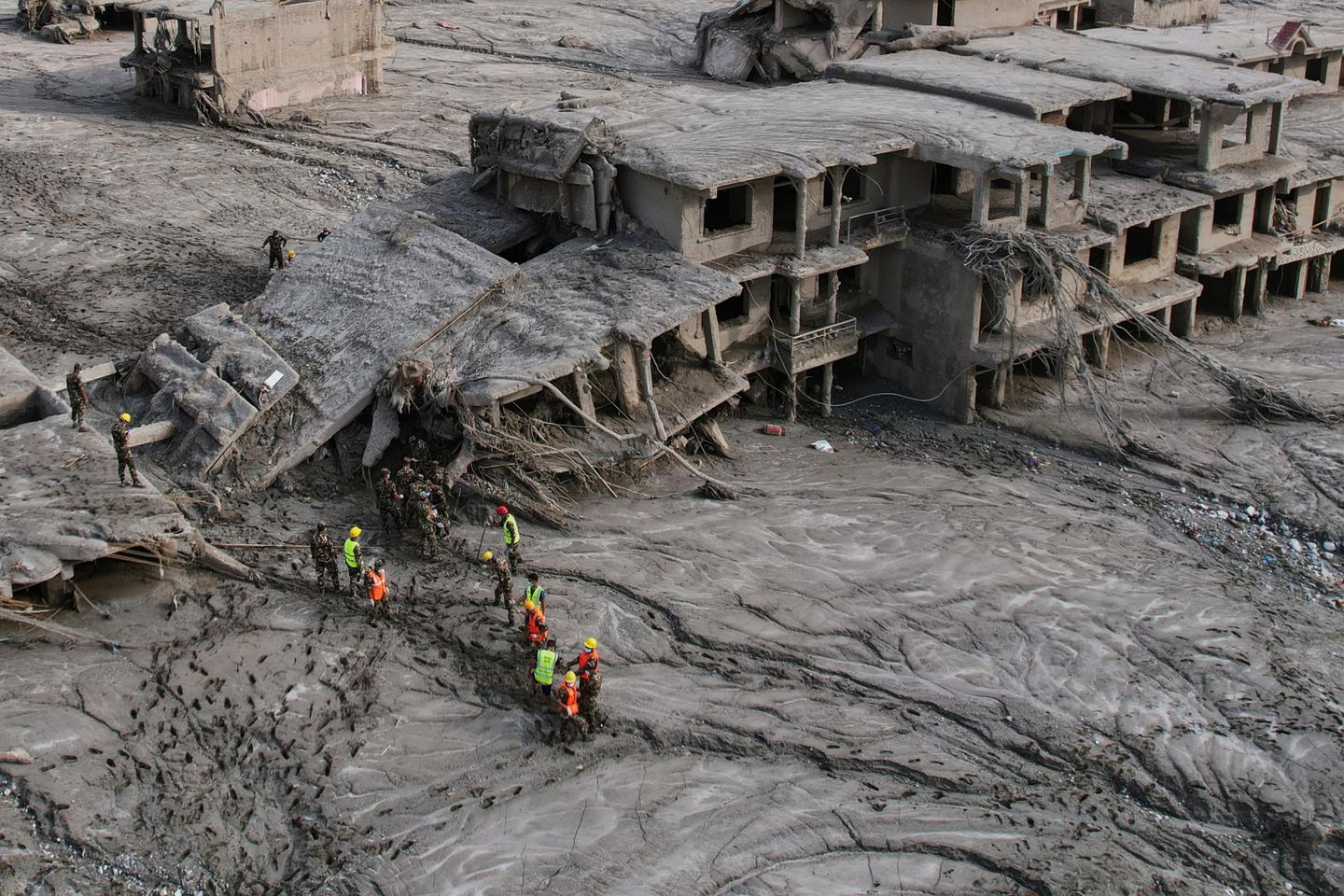
The Nepali army was able to insert a pipe into a tunnel in Nepal, where over 100 workers may still be alive. Disaster authorities urged rescue teams to exercise caution as rains and rising waters hampered efforts.
Rescuers in Nepal and China on Saturday, August 29, battled to locate thousands of people missing days after a deadly, tsunami-like wall of water and debris swept through the Himalayan region, engulfing entire villages. The floods have killed at least 734 people in Nepal and 2,498 remain missing, its disaster authority said Sunday, as rescue efforts entered a fifth day. Chinese state media earlier confirmed 16 dead in Tibet and 546 people missing, which takes the overall toll to 750 dead and 3,044 missing.
In a breakthrough late Saturday, the Nepali army was able to insert a pipe into a tunnel at the Trishuli 3A hydroelectric site where workers are believed to be trapped. More than 100 workers may still be alive inside such tunnels.
Teams had "started sending air through the small opening," Nepali Home Minister Sudan Gurung said in a statement. But efforts were hampered on Sunday by rains and rising river waters, with Nepal's disaster authorities urging rescue teams to exercise caution.
The US Geological Survey said a glacial collapse was behind the deadly torrent on Wednesday at the Nepal-Tibet border. While the exact cause of the collapse is unclear, climate change is causing glaciers to melt worldwide, increasing the risk of such disasters.
"The sudden glacial collapse and flash flood is a devastating reminder of how fragile these mountain environments can be," UN climate chief Simon Steill said in a statement. "We also know a warming climate, driven by humanity burning colossal amounts of coal, oil and gas, is making tragedies like this one, and so many others around the world, much more likely, frequent and severe, with vulnerable communities often hardest hit," he added.
'Enormous' trauma
Survivors face an agonizing wait to learn the fate of missing relatives, and the prospect of rebuilding their lives from nothing.
In an area home to vast energy infrastructure projects, Nepal's disaster authority listed 933 hydropower workers among the missing, along with 517 foreigners, including trekkers and Hindu pilgrims to Tibet's sacred Mount Kailash.
The United States will provide $3.6 million in humanitarian aid to Nepal, the State Department announced Saturday, including emergency food assistance. This came after Washington pledged $500,000 in the initial aftermath of the disaster.
Nepal's Foreign Minister Shisir Khanal said the reconstruction bill could run into "billions of dollars."
"The urgency is on rescue and saving lives as much as we can," he said, appealing for specialized assistance, including heavy-lift drones and technology to help locate people who are trapped. He also called for forensic testing kits to identify bodies and freezer units to store them, saying bodies that have been in water could decompose at a faster rate.
Fears of further flooding
Fears of further flooding have compounded the search for the missing. The deluge of ice and mud caused huge lakes, and one of these formations has become a risk.
The Chinese and Nepalese foreign ministers spoke Saturday and discussed sharing satellite and hydrological data, both sides said. In Tibet, where Chinese authorities are the only source of information, rescue operations were temporarily paused at the hardest-hit area of Gyirong over the risk of more flooding from a newly formed lake.
But state broadcaster CCTV said late Saturday that the lake was "discharging naturally" and had been "essentially drained," citing China's ministry of water resources. A total of 2,141 rescuers were near the Gyirong site, the Xinhua state news agency reported, including the more than 500 in the worst-hit area.
Le Monde with AFP


