You call that a bicycle?
Scooter layout makes pedaling a bad experience. But it does have pedals.
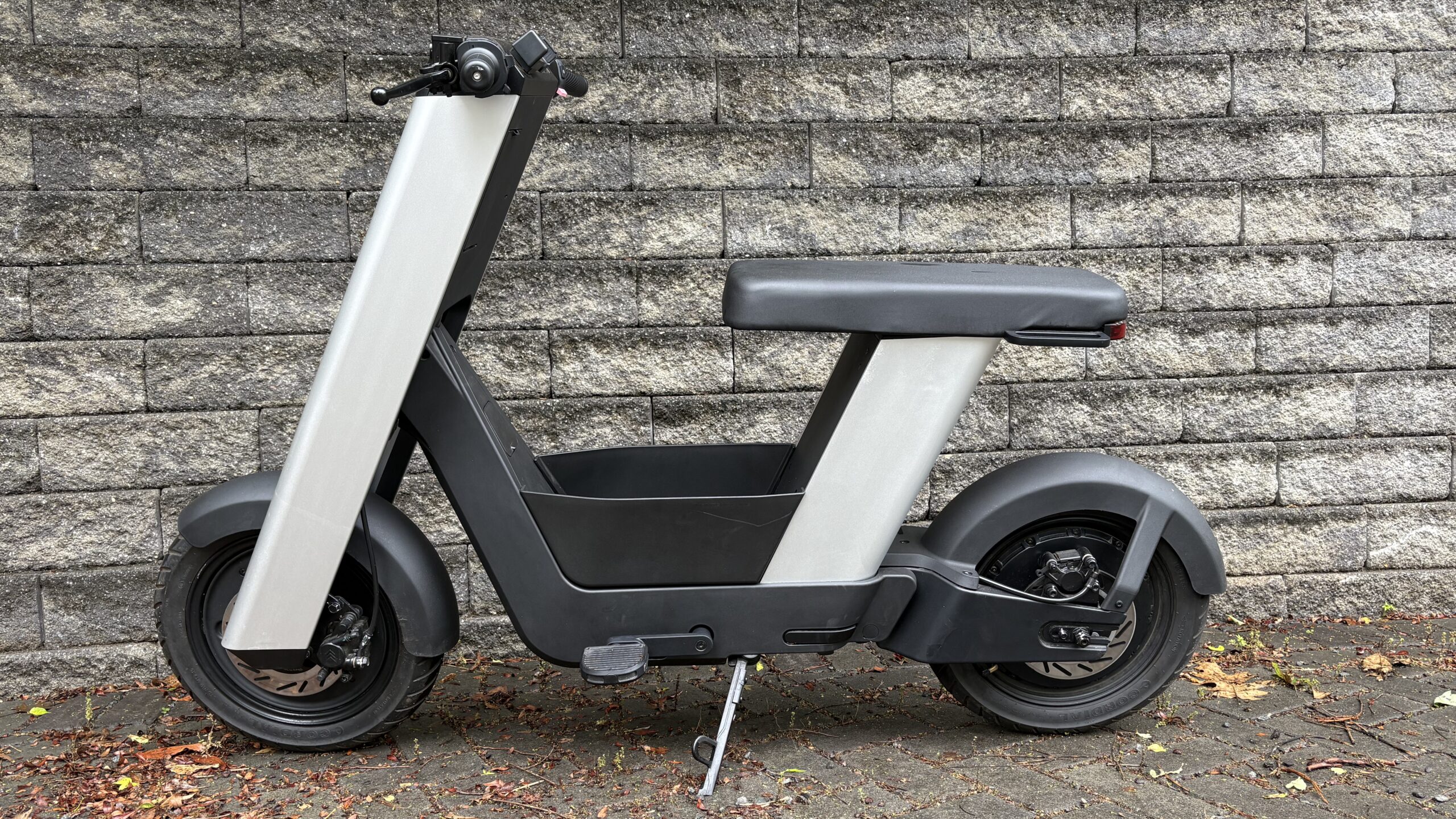
The Infinite Machine Olto. Credit: John Timmer
The Infinite Machine Olto. Credit: John Timmer
The Infinite Machine Olto is a great electric scooter, one with an overall layout that echoes the classic Vespa. It’s comfortable, and it accelerates well, handles nicely, and has a capacious battery. It has a rugged design that seems capable of handling a lot of abuse, but it also comes with thoughtful touches and security features that mean you can park it anywhere with confidence. And it provides all that at less than half the cost of its full-featured stablemate, the P1 scooter.
The reason is that the Olto is also a bicycle. Sort of.
This may technically be a bicycle, but it’s not one you’d ever want to pedal. While you can set it to operate as either a Class 2 or Class 3 e-bike, it works best when the pedals are both locked in a forward position, acting as footrests. The Olto was designed to provide riders with the experience of a scooter while still allowing them to take advantage of the growing bike lane networks in many urban areas across the country.
It’s impossible to review the Olto as a product without considering what its category represents: an explosion in electrified personal transport, with all forms looking to share infrastructure initially set aside for bicycles. We’ll look at the product first, but we’ll also consider its implications.
Bicycle by technicality?
We talked a bit with the Olto’s designers at Infinite Machine, who are cyclists based in New York City, about what they were trying to accomplish with the design. They described a local scene familiar to anyone who has visited NYC in recent years: ubiquitous bike lanes with a steady stream of traffic, almost all of it electric, and much of it not pedaled. If so many people were already riding their bikes as scooters, the designers reasoned, why not give them the benefits of a true scooter experience while still staying within the legal definition of a bicycle?
So the Olto has pedals. And you can hypothetically pedal it, though I couldn’t find a way to do so without the electric assist. Using the phone app, you can switch between Class 2 (assist or throttle up to 20 mph/32kmph) or Class 3 (no throttle, assist up to 28 mph/45 kmph). But the seat is low relative to the pedals, and it’s so wide that there’s no way to rotate your legs without your thighs slamming into it.
Instead, it’s meant to be kept in Class 2 mode and operated with a twist throttle. In this mode, you might as well stow the pedals. That involves reaching under the cranks to click a switch that disconnects the cranks from the drive system and then pulling the right crank away from the machine, at which point it will rotate freely. Two pegs can be extended from the Olto’s body to hold the pedals in their furthest forward position, where they serve as footrests. The maneuver is somewhat fiddly, but it can be done in less than a minute once you’re used to the process.
The Olto has a battery that holds enough charge for a lot of riding, held under the seat.
Credit: John Timmer
The Olto has a battery that holds enough charge for a lot of riding, held under the seat. Credit: John Timmer
Infinite Machine’s phone app provides access to two Class 2 modes that differ in how quickly they accelerate. The slower one would be appropriate for stop-and-go traffic, since the quicker acceleration would make it difficult to match the speed of the cars around you. The higher acceleration setting is a lot of fun when you have the road mostly to yourself.
I did have one problem with the quick acceleration. At about 175 lbs. (80 kg), the Olto is a beast, and it’s tough to move around by hand if you’re trying to fine-tune where you’re parking it. At one point while doing so, I accidentally twisted the throttle, and it leaped forward out of my hands and away from where I was standing (fortunately, this occurred in my driveway). A weight sensor in the seat would go a long way toward eliminating this risk by ensuring that someone is in the driver’s seat before sending power to the wheels.
Aside from that, Infinite Machine went with a fairly minimalist aesthetic. Beyond the throttle and brake levers, there are only a few controls. One switch operates the Olto’s turn signals (rear-only, unfortunately). It activates the appropriate side when pushed either left or right, but shutting them off requires you to depress the switch while it’s centered, which I found a bit tricky to get right. At least the Olto has clear indicators, so it’s obvious when they’re on or off.
Rounding out the controls are a power button and a button for the lights (which can switch between two angles of forward illumination, the higher one making you more visible to cars). There’s also a boost button, which is a bit problematic. It was described to me as useful for giving extra power on hills, and it certainly did work in that regard. But it also worked well on the flats, where it would accelerate the Olto up to 30 mph (nearly 50 kmph), which is 1.5 times its supposed legal limit. We’ll come back to that.
Overall, I found the Olto to be a great ride. The thick scooter tires gave it confident handling and smoothed over bumps and potholes. It had a lot of pickup, and the scooter form factor was extremely comfortable—the long seat, meant to hold two people, allowed me to stretch my legs. I definitely enjoyed running errands with it. But I would never, under pretty much any circumstance, recommend trying to pedal it.
Design and security
The Olto is offered in two different trims, one a Darth Vader-style all-black and the other with silver cladding. We received the latter, and it definitely has a Cybertruck vibe, something a passerby noted to me. The design is striking enough that I had multiple people come up to ask about it—that hasn’t happened since I reviewed the striking Vintage design. Overall, it comes across as a modern update of the traditional scooter.
As mentioned above, in scooter mode, the pedals rest on a small bit of metal that can extend from the frame or be clicked into the scooter’s body and held out of the way. Similar devices can extend out to serve as footrests for passengers, and there are handles under the rear of the seat for them to hold on to. I’m a bit over 6 feet tall (185 cm), and I found myself sitting far enough back that rear passengers weren’t an option. If you’re planning to carry another person, this may be a concern.
A plastic-walled well in between the cranks serves as the primary storage if you’re using the Olto for some quick grocery shopping or similar errands, but it’s not enough to haul much. Infinite Machine sells a basket and rack, but they are nonstandard—and expensive.
The Olto’s display is pretty minimalistic, primarily showing the speed, the status of the lights, and directional indicators. If you want a clearer picture of the hardware, the machine is designed to be used in tandem with its cell phone app. There’s a clamp for the phone next to the screen, and a small hatch below allows access to a USB charging port; it has enough space to store long charging cords.
It’s most convenient to unlock the bike and the battery from the phone app.
While there’s a power switch, the phone is probably the easiest way to switch the Olto between its three modes: on, off, and locked. The latter is a security mode for when you have to leave the Olto parked outside. It locks the front wheel at an odd angle so it can’t be ridden in a straight line, and it causes the motor to resist any attempt to roll the Olto in either direction. That, plus the heavy weight, should provide significant theft deterrence, but the Olto’s kickstand also has a place to use a more traditional lock to fasten it to something. You can also set an alarm that will both sound and send an alert to your phone.
If you don’t want to use your phone, the company provides a couple of NFC cards, and there’s a reader on the handlebars that lets you unlock it (you can link up to 10 cards to one machine). You can also use the phone app to set the machine to auto-lock when shut down with the NFC card.
If someone manages to take off with your Olto, you can track its location. This is clearly the most security-conscious e-bike I’ve reviewed.
These features exist because the Infinite Machine expects some owners to leave the Olto stored outside. As mentioned above, it’s very heavy and awkward to move, making it difficult, if not impossible, to bring into an apartment or house if there’s no garage. Whether it makes sense to leave a vehicle outside will depend on where you live.
In any case, you’ll probably need to remove the battery to keep it charged. The phone app lets you unlock the seat, where a convenient handle will lift the battery out. Unfortunately, the charging dock is sold separately, and it’s (once again) expensive, at nearly $200. It seems a bit much to design the hardware around the expectation that it will need an external charger and then not include one.
Overall impressions
The Olto has some really nice design features, and its app is excellent (you should view it as a necessary part of using the scooter). It provides a great riding experience in scooter mode, feeling both maneuverable and responsive. It’s great for light errand-running, and it’s fantastic if you live where it’s not uncomfortably hot for much of the year, letting you avoid using a car in urban and suburban areas. While it’s expensive as a bike, at about $3,500, that’s cheaper than dedicated electric scooters with similar designs—the Olto is slower, but it avoids ongoing registration, licensing, and insurance costs.
Those are the pros. The cons include the boost button, which simply unlocks illegal performance. To get the most out of the Olto, you’ll probably have to invest in accessories that work only with the Olto and are quite expensive, compared to standard parts available from multiple suppliers. While nimble under power, it’s very awkward to move around when you’re not riding it. And while it was designed with urban environments and security in mind, it may need to be stored on the street in many of them, which might not always be a great option.
While the picture is a bit mixed on the Olto’s value, it’s crystal clear that this is not a bicycle in any sense. Instead, it’s a scooter designed to fit within the legal definition of a bicycle and take advantage of the rules that come with it. It has pedals, but everything else about it is scooter-like.
That raises the obvious question of how we should think about it.
Sharing infrastructure
There are two overlapping and only partly separable trends happening at the same time. The first is the electrification of everything, driven by our ability to manufacture massive amounts of cheap, high-quality batteries. This includes e-bikes and Vespa-style scooters, as well as simple scooters with two small wheels, skateboards, one-wheeled balance boards, and whatever these things are called. These vehicles often take advantage of infrastructure originally set aside for bicycles but can come with features—much higher speeds, much heavier weights—that can increase the risks for cyclists.
At the same time, many areas are expanding this type of infrastructure, triggering a backlash against cyclists from people who resent the loss of lanes and parking spaces dedicated to cars.
This creates a bunch of trade-offs that can be difficult to optimize. As a cyclist, I think anything that gets people out of cars is a positive—even with its added heft, I’d much rather share the road with an Olto than a typically monsterized SUV or truck. But I’m less excited about sharing a busy bike lane in a crowded city with one, given that it has the weight to bump me out of said lane and into traffic if it’s operated carelessly.
I also recognize that the opposition to expanding bike infrastructure is fueled in part by bad behavior and the equipment that enables it, some of which is, shall we say, of questionable legality. So as much as possible, I’d like to see the hardware stay clearly within the legal lines. The Olto, by contrast, is designed to push right against them and, whenever the boost button is hit, cross them.
So I find myself appreciating, and even admiring, the motivations of the people behind the Olto: getting people out of cars, taking full advantage of cycling infrastructure, and electrifying transit. But I’m less convinced that the Olto is the right expression of those goals.
John is Ars Technica's science editor. He has a Bachelor of Arts in Biochemistry from Columbia University, and a Ph.D. in Molecular and Cell Biology from the University of California, Berkeley. When physically separated from his keyboard, he tends to seek out a bicycle, or a scenic location for communing with his hiking boots.
49 Comments


