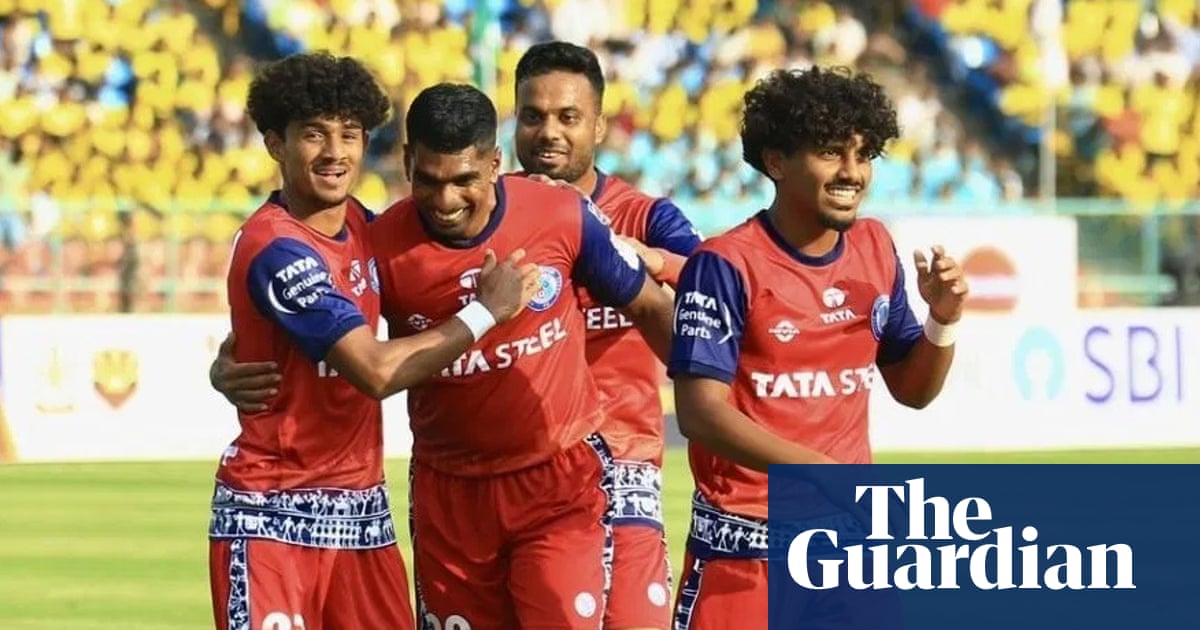
“Please don’t let this be the final whistle for Jamshedpur FC,” the defender Pratik Chaudhari said, looking into the camera as teammates looked on disconsolately. “We would like to say on behalf of all the players, please do rethink about this. Because if this happens, this is not just a loss for Indian football … this is a big loss for all of India.”
In addition, fans of the Indian Super League club marched in protest, petitions were launched, and the Indian football legend Sunil Chhetri said it was a “punch to the gut” and joined others in begging for a rethink.
The target of all these pleas was the Jamshedpur owner Tata Steel, which surprisingly pulled the plug on the club on 31 July. After the problems of the 2025-26 campaign, which started five months late and lasted just 13 games, the new season’s big kick-off on 4 September was to be a new start. The positivity and optimism before the new season, fragile though it was, disappeared along with JFC.
And understandably so as it is a huge blow, for players, staff and fans but also for the league. Jamshedpur had solid support and won the ISL shield in 2022, five years after the club was formed. Steve Coppell was the first head coach with Scott Cooper, Aidy Boothroyd and Owen Coyle all following in his footsteps.
Baljit Singh of Inventive Sports was the agent who took Coppell to the city in the eastern state of Jharkhand. “To be quite frank, after all the uncertainty Indian football has faced over the last couple of seasons, Jamshedpur FC would have been one of the last clubs I expected to pull out,” he told the Guardian.
The club was founded by the Tata Group, which has been involved with Indian football at various levels for decades. “When an institution with that history decides it can no longer continue at the highest level, it says something very serious about the current state of the game,” Singh said.
The league is also losing a major corporate backer, one which insists, however, that the decision is not about money. “At Tata Steel, sports have never been evaluated through a profit-and-loss lens,” the company’s vice-president and the club’s chairman, Sundara Ramam, told the Guardian.
Jamshedpur FC won the Indian Super League shield in 2022 Photograph: Courtesy of ISL“Our decision to exit professional club football has nothing to do with Tata Steel’s financial position. In fact, the resources that would have been spent on the club will continue to be invested in grassroots sports development. Our sports budget is not decreasing. It will continue to grow. As chairman of Jamshedpur FC, I can say clearly that this decision was driven by our desire to focus more intensely on grassroots development and not by financial considerations.”
Yet if others follow suit then there may not be much of a professional pathway for young talent. This latest episode shines a light on the league once more. In the club’s original letter sent to the All India Football Federation, concerns were expressed about the financial model of the ISL, which recently changed. Reliance Industries was the federation’s commercial partner from 2010 but, when that agreement expired in 2025, a new deal was not made and a new partner not found, hence the shortened season.
This time, the FA looks after governance and administration with the clubs taking on the commercial and marketing side. “The old model meant clubs had very little say in how the league was packaged and sold,” Ravi Puskur, the chief executive of Goa FC, said last month.
“Now the clubs hold the broadcast and sponsorship rights directly. It puts the incentive to grow the league’s commercial value in the hands of the people who are most invested in it growing.”
skip past newsletter promotionafter newsletter promotion
A member of Jamshedpur’s staff told the Guardian that the decision was because of concerns over the new arrangements. “I believe Tata are not interested in the club-led model,” he says. “There had to be a commitment of four years and the AIFF was asking for an initial payment of around £43,000 from all 14 clubs to be made by 31 July. Tata might have thought it’s better to stop rather than get dragged into unknown waters.”
The former Crystal Palace manager Steve Coppell was the club’s first head coach in 2017. Photograph: The India Today Group/Getty ImagesIt is a worrying exit as this is not the only corporate departure from Indian football of late. “Reliance stepping away from its central role was significant,” Singh says. “City Football Group leaving Mumbai City was another warning.” That happened in December, in the middle of the problems last season. “Tata now withdrawing from Jamshedpur FC feels different again because of the group’s deep-rooted history in Indian football. These departures have happened for different reasons, but collectively they represent a major loss of confidence in the professional game.”
Now there is fear that others may follow and there will be some relief if all 13 remaining clubs kick off the season. “Indian football can recover, but we should not underestimate the scale of the challenge,” Singh says.
“The priority now must be the people affected, followed by urgent clarity over the league’s structure and future. Players, staff and supporters cannot continue living from one period of uncertainty to the next. They deserve much better.”
There is still hope that Tata could have a rethink. “I understand that some tough decisions in sport are down to what makes sense in the boardroom,” Chhetri said. “But I can only request and hope that the thinktank at Tata picks their heart over head and reconsiders this call. It might be a poor business decision, but it will be the one Indian football needs the most at this hour.”