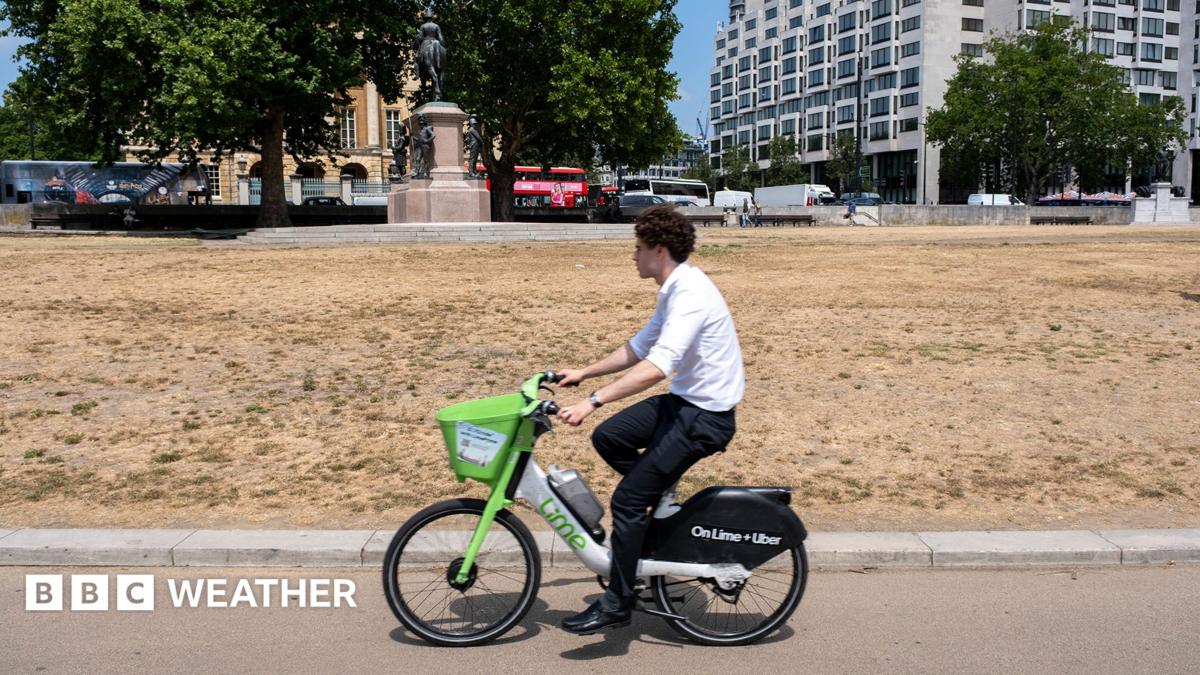
Parts of southern, central and eastern England are now close to drought, according to the National Drought Group, external.
As of Monday, East Anglia, the West Midlands, Devon, Cornwall and the Isles of Scilly, Lincolnshire and Northamptonshire, Hertfordshire and London, Wessex, Thames, Solent and the South Downs, are in "prolonged dry weather", the stage before drought.
The group, which brings together the Met Office, the National Farmers' Union, water companies and other expert bodies, made the announcement on Tuesday.
It comes as a further 10.1 million people are to be impacted by a hosepipe ban, as Thames Water announces a hosepipe ban for all its customers from Thursday.
The latest announcement means that more than 20 million people will be living under hosepipe bans by the end of this week. Agriculture and wildlife are also experiencing consequences.
There is pressure on public water supplies with demand increasing by up to 30% on the hottest days this July. Seven water companies have implemented or announced future hosepipe bans to reduce the strain on treatment works and storage during peak demand.
A hosepipe can use a thousand litres of water an hour, more than a family of four will use in a day.
Farmers have had to begin their harvests early and there have been warnings that cereal yields may be affected by the lack of rain.
Farmers and growers are "working around the clock to harvest crops which have come early, keep fruit and vegetables watered, and care for their livestock", according to Paul Tompkins, deputy president of the National Farmers' Union.
"Parts of the country, particularly in the east and south, have seen exceptionally low rainfall this spring and summer," he said, which could mean, "another difficult and expensive harvest after extreme weather impacts in both 2024 and 2025".
Summer so far has been exceptionally hot and dry across much of the UK, with three widespread heatwaves and the longest run of dry days in central England since 1995. England, Wales and eastern Scotland have been the driest areas over recent weeks, and this follows a very dry spring in similar regions.
England has received only 3% of its long-term average July rainfall with the south and east of England seeing no rain at all. Wisley in Surrey has seen 33 consecutive dry days.
Rainfall so far this summer has been below average across the UK as a whole, but there has been large regional contrast.
Up to the middle of summer - 15 July - parts of eastern and north-eastern England had received just 26% of their total expected summer rainfall. Areas of northern and western Scotland had more than average for the first half of the summer, though.
In Wales, where just 5% of July rainfall has fallen, Natural Resources Wales has moved the worst affected regions in the north and south-east into "prolonged dry weather status", the first step in its drought plan.
Comparisons are being made with last summer, when drought was declared across much of England, Wales and eastern Scotland. It officially ended just four months ago.
This year, drought has not developed as quickly because heavy rainfall recharged our aquifers, rivers and reservoirs during a very wet autumn and winter.
However, the UK Centre for Ecology and Hydrology says flash droughts, external with a sudden transition between wet and dry conditions are "likely to happen more often, and be more intense".
As the effects of human-induced climate change continue, the Met Office expects our summers to become hotter and drier, external in the future. In fact, by 2070, our summers could be up to 60% drier and 1-6C warmer compared to 1990.