coverage endedJul 28, 2026, 9:15 PM
Live updates: Crypto climbs off worst levels as stock selloff is contained to AI names
While the chipmakers continue their tumble, the DJIA is actually higher by more than 1%, led by Coca-Cola, Walmart, and Home Depot.
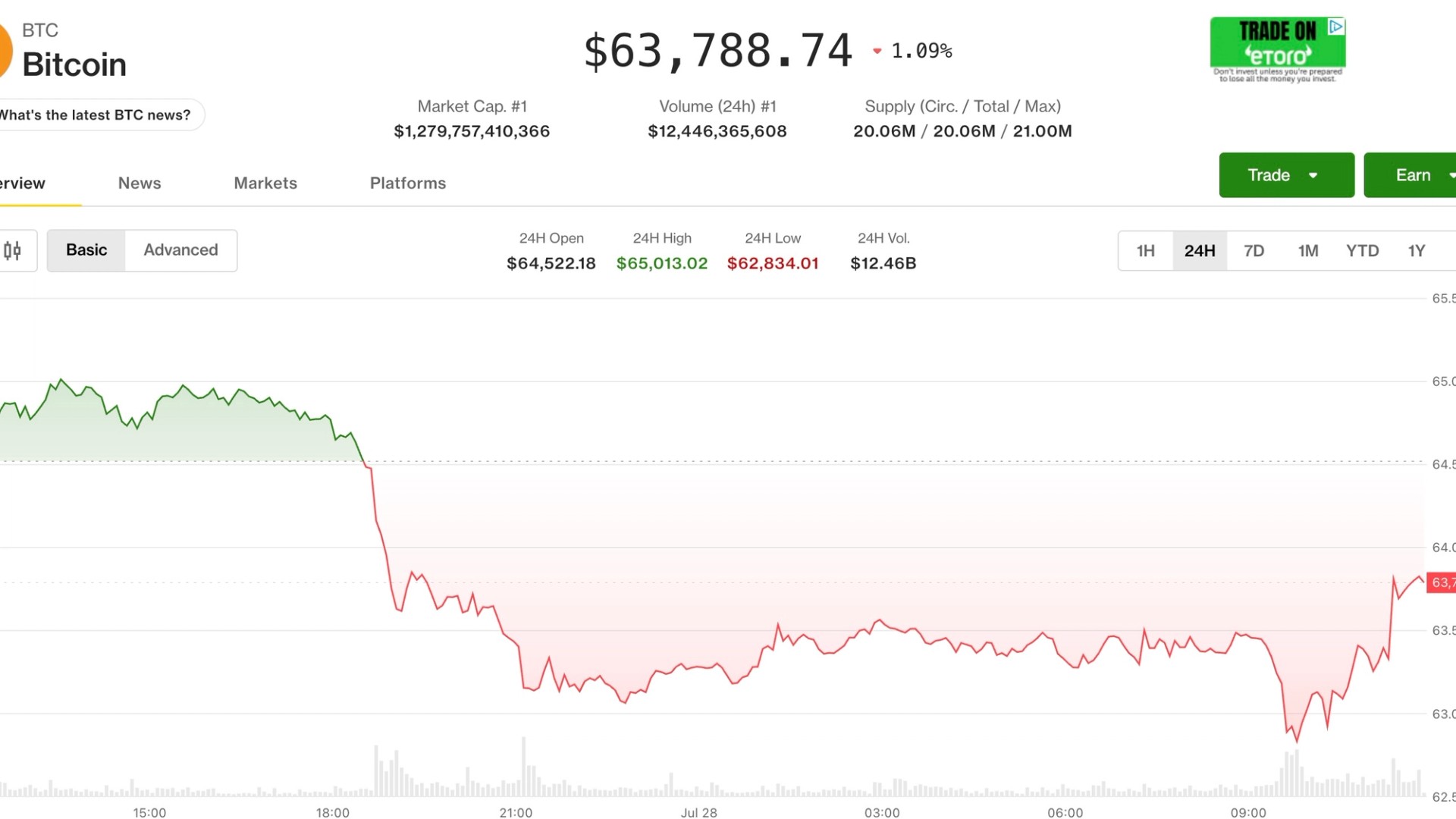
Bitcoin climbs off worst levels (CoinDesk)Seagate bolsters shaky AI sector after earnings beat
Data storage bellwether Seagate Technology (STX) is higher by 7% in after-hours trading after topping fiscal fourth quarter earnings and guidance estimates.
“Our performance is being driven by robust cloud data center demand and disciplined execution, and we see momentum continuing in 2027,” said CEO Dave Mosley. “As AI accelerates data generation and its value, we see durable long-term demand for mass capacity storage.”
Peer Western Digital (WDC) is higher by 5% alongside STX’s rise.
Both names have benefited from the AI boom and the resulting demand for mass data storage, but they have also suffered as that momentum trade has reversed over the past month.
Even with the recent sharp declines, STX and WDC each remain up about 150% year-to-date.
Grayscale's research head says Hyperliquid looks cheap compared with fintech stocks
Hyperliquid's native token HYPE (HYPE) may still be undervalued despite this year's rally, according to Grayscale Research, which argues the decentralized perpetual futures exchange trades at a discount to comparable fintech companies.
In a Tuesday note, Zach Pandl, Grayscale's head of research, estimated Hyperliquid could generate about $1 billion in earnings in 2027, driven by a recovery in crypto trading volumes and a new stablecoin partnership. Based on projected earnings per token, he estimates HYPE trades at roughly 15x-18x forward earnings, below many publicly traded fintech peers.
Pandl cautioned that the outlook depends on continued revenue growth and token supply remaining in check, with risks including weaker network activity or faster-than-expected token unlocks. Still, he said the valuation suggests HYPE remains inexpensive relative to traditional financial technology firms.
The note came as HYPE fell 3.4% over the past 24 hours, underperforming the broader CoinDesk 20 Index. The token is up 115% year-to-date but remains roughly 28% below its June record high.
Michael Saylor warns bitcoin's biggest risk comes from within
Michael Saylor has a new message for the Bitcoin community: stop worrying so much about outside threats and start paying attention to what's happening inside the network.
In a post on X, the Strategy executive chairman argued that Bitcoin has already "won" the battle for mainstream acceptance. Now, he believes the bigger risk is that the community could undermine the network by changing its core consensus rules too freely.
Saylor compared Bitcoin's rules to a constitution, saying they protect the network's scarcity, security and property rights. He warned that proposals involving larger blocks, covenants or transaction censorship could weaken those principles by adding complexity, reducing scarcity or interfering with Bitcoin's fee market.
His comments come as developers continue debating a range of technical upgrades. While supporters say the changes could make Bitcoin more useful, Saylor argued innovation should happen on higher layers built on top of Bitcoin, not by changing the protocol itself.
Goldman's momentum stock gauge goes negative for the year
In one of the more remarkable turnarounds in recent memory, Goldman Sachs’ High Beta Momentum basket of stocks is now negative for 2026.
Although we don’t know the exact makeup of the basket, it’s not difficult to imagine the high-beta, strong momentum names currently in it — i.e., AI infrastructure (chips/hardware) and other associated big tech.
The gauge started the year just above 500, soared to 850 in late June, and, in the space of a month, has retreated back to the 500 level.
Crypto climbs from worst levels as stock selloff seems contained to AI
Take away the AI chipmaking favorites, and the stock market is doing just fine on Tuesday.
While the likes of SanDisk, Applied Materials, AMD, Micron, and Intel are sporting major declines, the Nasdaq itself is flat for the session, with Microsoft and Google posting 2% advances.
The Dow Jones Industrial Average (which includes MSFT and GOOG) is higher by 1.2%, with Coca-Cola up by 6% after an earnings beat. Walmart and Home Depot are higher by 2%-3%, and healthcare names like Eli Lilly and Amgen are also solidly ahead.
The S&P 500 is up 0.4%.
After falling below $63,000 in the early post-opening rout, bitcoin has climbed back to $63,800, still lower by 1.1% over the past 24 hours.
Possibly helping sentiment in broader markets, traders are rapidly pulling out of bets that the Fed was going to surprise with a rate hike tomorrow. With oil surging during July, the odds of a rate hike this week had surged to nearly 40% at one point yesterday. Those odds have been trimmed to 28% over the past few hours, according to CME FedWatch.
Also a boost, the price of oil continues to fall. Despite no particular “news” out of Iran and an apparent continued lack of traffic in the Strait of Hormuz, WTI crude is down another 5% on Tuesday to $78.50 per barrel. At one point last week, it had nudged against $90.
Brent crude is also lower by 5% to $81.50 — that’s down nearly 20% after topping $100 late last week.
PayPal not ruling out a sale
“If we see levers or a path that we believe would create superior value for our shareholders than executing our current strategy, we would, of course, carefully consider [a sale],” said PayPal CEO Enrique Lores on the company’s second-quarter earnings call Tuesday morning.
As for Stripe’s reported $60.50 per share offer, Lores said the company would not comment on market speculation.
Read more: Stripe’s $53 billion PayPal bid is a high-stakes play to own the future of digital payments
In the meantime, PayPal topped analyst estimates, and Lores said the company is making good progress on its sizable restructuring plan, which includes major cost savings over the next three years.
PYPL is up 4.15% on Tuesday to $58.40.
Visa cuts 7% of its workforce
Visa is cutting about 2,600 jobs, or roughly 7% of its workforce, as CEO Ryan McInerney looks to streamline operations and redirect investment toward higher-growth areas, according to a Bloomberg report.
The layoffs will primarily affect the company's technology and product teams. In a memo to employees, McInerney said the cuts are intended to improve efficiency and allow Visa to reinvest in its "highest potential opportunities."
The restructuring comes just weeks after Visa expanded its digital asset strategy with the launch of the Visa Stablecoin Platform, an enterprise service designed to help banks, fintechs and crypto firms issue, store, transfer and redeem stablecoins. The platform underscores Visa's continued investment in blockchain-based payments even as the company trims costs amid rising competition across the payments industry.
Crypto-related stocks down big across the board
The Nasdaq is lower by another 1.35% on Tuesday and is on the verge of slipping 10% from its June peak, commonly called a “correction.”
That’s pulling crypto prices out of their very tepid rally of the past few weeks, and sending crypto-related stocks down sharply.
Strategy (MSTR) is down 4.4%, Coinbase 3.5%, and Circle (CRCL) 5.5%.
The data center names — which had been bid sharply higher as part of the AI momentum trade ‚— are being hit particularly hard. Galaxy Digital (GLXY) is down 11.7%, Hut 8 (HUT) 11.8%, MARA Holdings (MARA) 9%, IREN (IREN) 10%, Cipher Mining (CIFR) 11.1%.
Bitcoin is down 2.8% to $63,100, while ether (ETH) is off 3.5% to $1,876.
Chip names down sharply early following Kospi's overnight plunge
Among those falling: Micron (MU) -10%, SanDisk (SNDK) -12%, Applied Materials (AMAT) -7%, Seagate (STX) -13%, AMD (AMD) -9%, Marvel (MRVL) -10%.
SK Hynix (SKHY) is down 9.3% to $130, or more than 10% below its IPO price of $149.
The VanEck Semiconductor ETF (SMH) is off 4.4% and the iShares Semiconductor ETF is lower by 5.6%.
The broader Nasdaq is down just 1.3% thanks to modest strength in Microsoft, Google, Apple, and Amazon.
Bitcoin continues to slide, down 3.5% over the past 24 hours at $63,000.
Morgan Stanley launches Ether and Solana ETPs
Morgan Stanley has expanded its digital asset lineup with the launch of an ETF tracking ether (ETH) and Solana (SOL), building on the debut of its spot bitcoin (BTC) ETP earlier this year.
The new Morgan Stanley Ethereum Trust (MSSE) and Morgan Stanley Solana Trust (MSOL) will trade on NYSE Arca and track the CoinDesk Ether Benchmark 4PM NY Settlement Rate and CoinDesk Solana Benchmark 4PM NY Settlement Rate. Each carries a 0.14% expense ratio which is the lowest on the market. Both products also intend to stake a portion of their holdings, with staking rewards passed through to investors rather than retained by the firm.
Morgan Stanley's bitcoin ETP, launched earlier this year, has attracted more than $381 million in assets under management through July 16, while the firm's ETF and ETP lineup now manages more than $14 billion across 22 products.
Ionic Digital (remember Celsius) going public today
Formed from the assets of now-jailed Alex Mashinsky’s bankrupt Celsius’ bitcoin mining operation, Ionic Digital (IOND) is going public today on the Nasdaq under a direct listing, with a reference price of $53.
Needless to say, in the current environment, Ionic describes itself as a digital infrastructure company catering to the power needs of AI and high-performance computing. Ionic, though, continues to mine bitcoin and maintains a modest bitcoin treasury.
Galaxy Digital boosts data center operation with Texas land acquisition
Mike Novogratz’s Galaxy Digital (GLXY) announced on Tuesday a development agreement and acquisition of 500 acres in McGregor, Texas.
The initial phase of the development is expected to reach 74 MW.
”This is exactly the multi-campus strategy we’ve been talking about,” said CEO Mike Novogratz. “Demand for compute is a structural shift, and Galaxy is building for it.”
GLXY is lower by 3% pre-market as the AI momentum trade continues to stumble, pulling down data center names as well.
BItcoin falls back to $63,000 as South Korea's Kospi crashes nearly 11%
The chipmakers remain under pressure, with plunges in South Korea’s Samsung and SK Hynix leading the Kospi’s 10.8% decline overnight.
The Kospi is now down 34% after peaking one month ago.
The China threat continues to grow, with The Information yesterday reporting that a Beijing-backed company has begun manufacturing deep ultraviolet (DUV) lithography machines, like those produced by Netherlands-based ASML. ASML was lower by 5.8% on Monday and down another 4.7% in pre-market trading.
Previously, mostly ignoring the troubles in the formerly piping-hot chip sector, crypto prices slid alongside the Kospi overnight, with bitcoin (BTC) now down more than 2% over the past 24 hours at $63,400.
Other majors like ether (ETH), XRP (XRP), and solana (SOL) are down closer to 3%-4%.
The Fed begins its two-day policy meeting today, with investors split over whether the U.S. central bank will or will not hike interest rates on Wednesday.
Bitcoin’s next move hinges on $68,500 breakeven level, Bitfinex analysts say
Heading into Wednesday’s Fed rate decision, the key level to watch in bitcoin is the short-term holder cost basis near $68,500, which is the aggregate break-even price of coins held by investors for less than 155 days.
That’s the latest take from analysts at the crypto exchange Bitfinex. This threshold is the first major resistance that could shape Bitcoin’s mid-timeframe trend.
“There is significant structural resistance at the $68,500 level, and as prices rise toward break-even, many investors will likely sell to exit at parity. If the price clears this barrier, volume analysis points to an “air pocket” before the next major resistance at $84,000, similar to the one that led to rapid price expansion during the mid-May move from $67,000 to $80,000+,” analysts said in an email.
Live updates: Bitcoin trims losses even as Nasdaq futures hit 3-month lows
Bitcoin (BTC) has regained some poise, recovering from Asian session lows despite signs of worsening risk aversion in equity markets.
The leading cryptocurrency by market value traded at around $63,500 as of this writing, up from the low of $63,065 in Asia, according to CoinDesk data. Prices are still down by 0.3% since midnight UTC and by nearly 3% over the past 24 hours.
In the meantime, e-mini futures tied to Nasdaq have slipped to 27,930 points, the lowest since May, and are down 1.2% for the week, having peaked near 31,000 in June. On Monday, shares in NVDA, the index heavyweight, fell by nearly 5%.
Earlier today, South Korea’s Kospi index tanked by 10%, alongside relatively more measured declines in other regional indices, such as Japan’s Nikkei.
- 1
- 2
- 3
- 4
- 5
- 6
- 7
- 8
- 9
- 10
Crypto Flows, Share and the Selective Rotation
Crypto Flows, Share and the Selective Rotation
Markets repositioned since June, but Binance held share (~55% user funds, ~24% spot) and drew net inflows in early July while the tracked market saw outflows.
Jul 22, 2026
Markets repositioned since June, but Binance held share (~55% user funds, ~24% spot) and drew net inflows in early July while the tracked market saw outflows.
Why it matters:
Markets repositioned since June, but Binance held share (~55% user funds, ~24% spot) and drew net inflows in early July while the tracked market saw outflows.
View Full Report