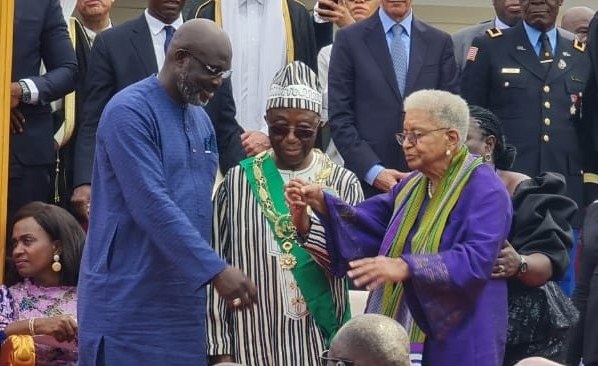
Former President George Manneh Weah's declaration that he will seek the presidency again in 2029 is more than the opening of another election campaign. It reopens one of the defining political debates of post-war Liberia: Was his presidency an interruption in the country's democratic progress or an unfinished project deserving of a second chance?
More immediately, the announcement ensures that the next three years will become an extended contest not only over President Joseph Nyuma Boakai's record in office, but also over Weah's own legacy--and even over former President Ellen Johnson Sirleaf's controversial role in the political transition that brought him to power in 2017.
Speaking before supporters at the Coalition for Democratic Change (CDC) USA Convention, Weah formally declared that he would once again seek the presidency.
Follow us on WhatsApp | LinkedIn for the latest headlines
"I will be a candidate in 2029... for the Presidency of the Republic of Liberia in 2029, with your support and blessings, and the mandate of the Congress of the Congress for Democratic Change," Weah said to sustained applause.
The declaration ends months of speculation about his political future. It also signals that Liberia's next presidential race has effectively begun more than three years before voters are due to cast their ballots.
But unlike his first presidential bid in 2017, Weah enters this race as a former head of state whose record is well known. Nor is President Boakai an untested challenger. By 2029, Liberians will have experienced both administrations and will be in a position to compare them directly.
That reality makes the coming election fundamentally different from previous contests. Rather than choosing between promises, voters are likely to weigh two contrasting records of governance.
Throughout his address, Weah sought to define the terms of that comparison.
He accused the Boakai administration of reversing democratic gains made during his presidency, weakening public institutions and presiding over worsening economic hardship.
"Families are struggling to eat. Businesses are collapsing under the weight of a bad economy and high taxes. And the Liberian people's confidence in their own institutions has been broken," he said.
He also alleged that executive interference in government had reached unprecedented levels.
"The level of executive interference into government has never, never in the history of our post-war democracy been as pronounced, as reckless, or as dangerous," Weah declared.
Describing the situation as a constitutional crisis, he argued that Liberia's democratic institutions were under sustained assault.
"Let us call it what it is. This is not governance. This is a systematic, calculated assault on the rule of law."
Those criticisms are expected to form the backbone of Weah's campaign over the next three years. Whether Liberians ultimately accept that assessment may depend less on campaign rhetoric than on how they judge their own economic circumstances and the government's performance by the time elections arrive.
Weah also sought to present himself not as the leader of a single political party but as the focal point of a broader opposition movement.
"Our fight is not a fight of vengeance, and it does not belong to the CDC alone," he said.
Instead, he called for cooperation across political lines.
"We endeavor to work with every Liberian from every walk of life, from every political party."
His appeal suggests that the opposition recognizes that defeating an incumbent president may require a coalition broader than the CDC itself.
Yet Weah's declaration inevitably revives another debate--one that has gained renewed attention in recent weeks following comments by Liberian cultural icon and longtime political ally of former President Ellen Johnson Sirleaf, Miatta Fahnbulleh.
Weah's declaration was quickly welcomed by his political allies. Dee-Maxwell Saah Kemayah, Sr., Political Leader of the Movement for Economic Empowerment (MOVEE), described the former president's decision as a response to what he called growing public demand for "tested, caring, people-centered, rule of law-based, peace-loving, development-driven, reconciliation-led and unity-focused leadership."
Kemayah argued that Weah's return represented "a national mission" to address the country's economic and governance challenges. The statement echoed many of the criticisms Weah himself directed at the Boakai administration during his address.
Reflecting on Sirleaf's post-presidential legacy during a recent interview, Fahnbulleh offered one of the sharpest public assessments yet of Liberia's political transition in 2017.
"Her lasting legacy will be that she unleashed George Weah on us. That's the legacy I give to Mrs. Sirleaf," Fahnbulleh said.
Although directed at Sirleaf rather than Weah, the remark has become part of a broader national conversation about the former president's years in office and the political decisions that shaped Liberia's recent history.
Weah's decision to seek another term now places that debate squarely before the electorate once again.
Supporters view his presidency as one that preserved peace, respected constitutional transfers of power and sought to expand opportunities for ordinary Liberians. Critics argue that his administration fell short on economic management, governance and the fight against corruption.
In many respects, Weah's return forces Liberians to revisit unresolved questions from the country's last political transition. Was the 2023 election a rejection of George Weah, or merely a temporary embrace of Joseph Boakai? And if Boakai fails to meet public expectations over the next three years, could Weah's presidency come to be viewed differently in hindsight?
The 2029 election therefore appears set to become more than a contest between political parties. It is shaping into a referendum on competing interpretations of Liberia's recent past.
Sign up for free AllAfrica Newsletters
Get the latest in African news delivered straight to your inbox
For President Boakai, the challenge is equally significant.
With more than three years remaining in his first term, virtually every major policy initiative, economic reform and governance decision is now likely to be viewed through the prism of the coming election.
That dynamic carries both opportunities and risks. A strong economic recovery, improved public services and visible institutional reforms could strengthen the administration's case for a second term. Continued economic hardship or persistent governance controversies, however, would likely provide fresh momentum to the opposition's message.
In announcing his candidacy, Weah framed his decision as one of national responsibility rather than personal ambition.
"I have made it because you, the partisans who have never wavered, who have carried this movement, deserve a fight that matches your loyalty."
He concluded with a pledge to return to office.
"We will reclaim our democracy. We will restore our institutions. We will rebuild our beloved Liberia.
"We are coming back."
Whether Liberians ultimately agree will not be decided by convention speeches or campaign slogans. Over the next three years, the country will be weighing two presidencies, two competing visions of governance and two sharply different interpretations of Liberia's democratic journey.
That, more than Weah's declaration itself, may prove to be the real story of the road to 2029.