From
1h agoIran warns of 'eye for an eye' response if infrastructure hit
Further to that, Iran’s foreign minister Abbas Araghchi said Wednesday that Tehran would respond in kind to any attack on its infrastructure, after Donald Trump’s threat to bomb a bridge or power plant for every ship targeted in the strait of Hormuz.
“Our defence doctrine is clear: eye for an eye. Any aggression against Iran, including our infrastructure, will compel a powerful and decisive response,” Araghchi said on X.
Per my last post, Iran’s state broadcaster quoted the military as saying that US threats “will have no result other than the expansion of the war”.
Key events
48m ago
US has made 'no strategic gains' through war, says Iran's deputy foreign minister
1h ago
Iran warns of 'eye for an eye' response if infrastructure hit
2h ago
Iran's military says Trump's threats will lead to expansion of war in region and beyond, state media reports
4h ago
The day so far
7h ago
Oil price hops over $95 mark as Middle East conflict escalates
7h ago
‘It’s truly hell here’: airstrikes, repression and water shortages become ‘new normal’ for Iranians
8h ago
Trump: US will 'destroy' one bridge or power plant for every future Iranian Hormuz strike
8h ago
EU aviation agency asks airlines not to operate in Jordan airspace
8h ago
New round of talks between Israel and Lebanon to be held in Italy
9h ago
Iran foreign ministry: there is no nuclear activity at Pickaxe Mountain
9h ago
Oil price touches $95 as US-Iran conflict escalates
10h ago
Today so far
10h ago
Rubio warns that Iran's demand to control Hormuz threatents global economy
10h ago
Lebanese interior minister says US can help secure Israeli withdrawal from south
11h ago
Mamdani urges US government to arrest Netanyahu if Israeli PM visits US
11h ago
Number of vessels transiting the strait of Hormuz continues to drop
11h ago
Jordanian army intercepts four Iranian missiles
12h ago
Iran executes man for charges related to winter protests
13h ago
Beirut working for 'complete Israeli withdrawal', says Lebanon PM
13h ago
Houthis threaten to attack shipping tankers if they use Saudi Arabian ports on Red Sea
13h ago
Trump nuclear deal with Saudi Arabia could allow it to enrich uranium: report
14h ago
What is Iran’s Pickaxe Mountain, the site Trump has threatened to attack?
14h ago
Opening summary
US has made 'no strategic gains' through war, says Iran's deputy foreign minister
In a post on X, Iran’s deputy foreign minister said he met with 25 European ambassadors and chargé d’affaires in Tehran and outlined his country’s position regarding the conflict.
“I reminded them that in the 40-day war, we imposed a severe defeat on the aggressors. In this new round of military aggression as well, we will resolutely defend our homeland and national interests,” Kazem Gharibabadi posted.
“These wars have created no strategic gains for America and only endanger regional and global peace and security. I also said that Europe is expected to safeguard the United Nations Charter and international law and to condemn aggression,” he added.
“Of course, a few Europeans, such as Spain, adopted principled positions. European governments must take note that placing bases and territory at the disposal of the aggressor will rank them among the aggressors. Europe is expected to be the driving force of diplomacy, not a follower of the aggressor’s power.”
The price for a barrel of Brent crude oil, the international standard, rose 3.4% to $94.07 (£70) after briefly topping $95 to touch its highest price in nearly six weeks, AP reports.
That is up from less than $72 early this month, which is roughly where it was before the war with Iran. Rising oil prices are threaten to reaccelerate inflation. AP says that in turn could push the Federal Reserve and other central banks to raise interest rates, which would slow economies and undercut prices for stocks and other investments.
Iran warns of 'eye for an eye' response if infrastructure hit
Further to that, Iran’s foreign minister Abbas Araghchi said Wednesday that Tehran would respond in kind to any attack on its infrastructure, after Donald Trump’s threat to bomb a bridge or power plant for every ship targeted in the strait of Hormuz.
“Our defence doctrine is clear: eye for an eye. Any aggression against Iran, including our infrastructure, will compel a powerful and decisive response,” Araghchi said on X.
Per my last post, Iran’s state broadcaster quoted the military as saying that US threats “will have no result other than the expansion of the war”.
Iran's military says Trump's threats will lead to expansion of war in region and beyond, state media reports
We’re getting some lines through now from Reuters news agency. Iranian state tv is reporting that Iran’s top joint military command has warned that Donald Trump’s repeated threats will only lead to expansion of the war in the region and beyond.
It added that if the US acts on the threats, Iran will stop all Gulf oil flow and target oil, gas, electricity and economic infrastructure in the region.
Per my last post, Iran’s top negotiator and powerful parliamentary speaker, Mohammad Bagher Ghalibaf, warned on Wednesday that if Tehran cannot export its oil, no other country in the region would be able to do so.
Earlier, Trump threatened to destroy an Iranian bridge of power plant for each strait of Hormuz attack.
Iran’s top negotiator and powerful parliamentary speaker, Mohammad Bagher Ghalibaf, has warned that if Tehran cannot export its oil, no other country in the region would be able to do so.
He wrote on X:
The equation of this war is clear: either all or none!
In a region where we do not sell oil, no one will sell oil. If our security is not ensured, no infrastructure will be safe, and the security of the strait is in the absence of American forces. We have repeatedly said that the situation of the strait will not return to pre-war conditions.
He also repeated that the strait of Hormuz “will not return to pre-war conditions”, as he has warned several times before. Before the war was launched by the US and Israel on 28 February, around 20% of the world’s oil and liquefied natural gas flowed through the critical waterway.
The US military has redirected nine commercial vessels and disabled one since reinstating the US’s naval blockade against Iran on 14 July, according to US Central Command.
Donald Trump salutes the coffins of the US service members killed in the Middle East last week.
Donald Trump salutes as soldiers carry the flag-draped transfer case containing the remains of 1st Lt. Tyler James Feehan, 25, of Ewa Beach, Hawaii, who was killed while serving in Jordan Photograph: Saul Loeb/AFP/Getty ImagesThe day so far
-
Donald Trump threatened retribution against Iran in a post on Truth Social on Wednesday. “From this point forward, any time the Islamic Republic of Iran shoots at a ship in the Strait of Hormuz, whether it be by Missile, Rocket, Drone, or any other device or weapon, the United States will bomb and destroy ONE BRIDGE OR POWER PLANT, including those located next to, or in, the Capital City of Tehran,” the US president posted on Truth Social.
-
President Donald Trump is attending the dignified transfer today of four US service members killed in the Middle East. Trump will be at Dover Air Force Base in Delaware when the remains of the troops killed in action are returned to their families, the White House said.
-
Britain’s new prime minister has agreed to allow the US to continue to use UK airbases for bombing missions against Iran as the US steps up its attacks on the country. Andy Burnham endorsed a decision taken by his predecessor Keir Starmer at a Cobra meeting on Friday to allow the US to resume strikes from UK bases against Iranian missile launchers and sites around the strait of Hormuz.
-
A US missile struck the Iranian island of Larak on Wednesday, the Tasnim news agency reported, in the latest attack to target the Islamic republic’s islands in and around the strait of Hormuz. The islands have been hit multiple times as the two sides fight over the strategic waterway, which Iran has sealed following the collapse of a preliminary deal aimed at ending the war.
-
Yemen’s Iran-backed Houthis have been recorded sending radio warnings to ships, the International Chamber of Shipping told AFP on Wednesday, after the rebels announced a naval blockade of Saudi Arabia. “We can confirm that the Houthis were recorded transmitting a warning message to ships in the region,” the ICS said.
-
The price of oil has breached the $95 a barrel mark for the first time in six weeks as the escalating Middle East conflict threatens further disruption to global supplies. The benchmark oil price rose sharply on Wednesday as renewed US-Iran aggression over the strait of Hormuz was compounded by Houthi threats to target vessels carrying Saudi oil through the Bab el-Mandeb strait.
-
The European Union Aviation Safety Agency on Wednesday added Jordan to the no-fly list, asking airlines not to operate withint the airspace as “the security situation has deteriorated rapidly”, Reuters reports. Iran has been targeting sites in Jordan and other US Gulf states amidst the renewed conflict. Last weekend, two US military personnel members were killed in an attack on Muwaffaq Salti Air Base in Jordan.
-
Italian foreign minister Antonio Tajani said that a new round of US-mediated talks between israel and Lebanon are set to take place in Italy on 4 August, AFP reports. This comes after a round of talks between the two countries in Rome last week.
-
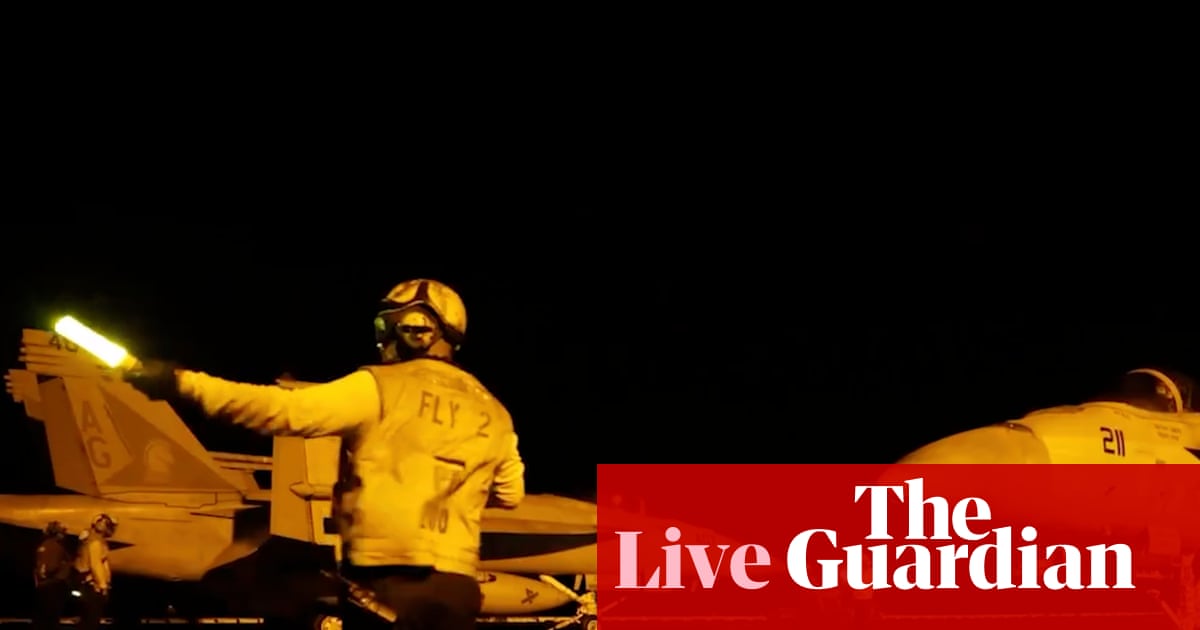
The US military completed its 11th night of strikes on Iran, including on aircraft hangars and drone storage sites, as the renewed conflict continues to undermine diplomatic efforts to salvage an interim ceasefire deal.
-
The Jordanian army said it intercepted four Iranian missiles on Wednesday with two additional missile falling in an open area, AFP reports. The two missiles that the army did not intercept fell in “two remote, uninhabited areas, without causing any human casualties or material damage” the army said in a statement.
-
Iran has executed a man after finding him guilty of charges related to protests that swept the country last winter, according to AFP. The Iranian judiciary announced on Wednesday that Iran has executed a man identified as Mehdi Khanaki, who was arrested on 10 February in Karaj, west of Tehran, while in possession of a large arsenal. Khanaki “was condemned to death and the confiscation of all his property for having acted in favour of the Zionist and American regimes,” the website said. These allegations could not be independently confirmed.
-
In Lebanon, the focus is on “a complete Israeli withdrawal from the south”, Lebanese prime minister Nawaf Salam said on Wednesday. Salam was visiting Zawtar al-Gharbiya, one of several “pilot zones” intended to demonstrate that the Lebanese army can remove and disarm Hezbollah as part of a Washington-sponsored deal with Israel, AFP reports.
Yemen’s Iran-backed Houthis have been recorded sending radio warnings to ships, the International Chamber of Shipping told AFP on Wednesday, after the rebels announced a naval blockade of Saudi Arabia.
“We can confirm that the Houthis were recorded transmitting a warning message to ships in the region,” the ICS said.
US president Donald Trump walks to board Air Force One as he departs for Dover, Delaware, to attend the dignified transfer of US Army service members killed in Jordan and Iraq, amid the Iran war at Joint Base Andrews, Maryland.
U.S. President Trump departs for Dover to attend dignified transfer for U.S. Army service members killed in the Iran war. Photograph: Evelyn Hockstein/ReutersZohran Mamdani, the mayor of New York City, said in a video statement that he didn’t have the authority to arrest Benjamin Netanyahu but he urged the federal government to do so if the Israeli prime minister visits the city in September.
Mamdani urges US government to arrest Netanyahu if he visits US – videoPresident Donald Trump is attending the dignified transfer today of four US service members killed in the Middle East.
Trump will be at Dover Air Force Base in Delaware when the remains of the troops killed in action are returned to their families, the White House said.
The ritual is one of the most somber duties of a commander-in-chief. It will be the third that Trump has attended since he launched the war in Iran in February.
Speaking to reporters on his way to Dover, Trump called it “one of the hardest things to do as a president.” His message to grieving families, he said, will simply be “we love you, we love your child.”
“There’s no games, there’s no nothing - that’s their child,” Trump said. “And all you can do is throw out your heart.”
Dan Sabbagh
Britain’s new prime minister has agreed to allow the US to continue to use UK airbases for bombing missions against Iran as the US steps up its attacks on the country.
Andy Burnham endorsed a decision taken by his predecessor Keir Starmer at a Cobra meeting on Friday to allow the US to resume strikes from UK bases against Iranian missile launchers and sites around the strait of Hormuz.
It is intended to be a continuation of a UK policy of permitting US ‘defensive strikes’ though it is unclear precisely how the distinction is drawn as Donald Trump threatens to bomb bridges and power plants in Iran.
US Air Force B-1 bombers were spotted at RAF Fairford on Tuesday. The Gloucestershire base is where US bombers are based in the UK, though the flight distance to Iran means they require refuelling support.
Burnham spoke to Trump on Monday, his first call with a foreign leader after becoming prime minister at lunchtime.
Trump said afterwards the two had “a very good conversation” while Downing Street said Burnham had told the US leader that “ensuring the security of the UK and its Allies was at the top of his agenda”.
A US missile struck the Iranian island of Larak on Wednesday, the Tasnim news agency reported, in the latest attack to target the Islamic republic’s islands in and around the strait of Hormuz.
The islands have been hit multiple times as the two sides fight over the strategic waterway, which Iran has sealed following the collapse of a preliminary deal aimed at ending the war.
Oil price hops over $95 mark as Middle East conflict escalates
The price of oil has breached the $95 a barrel mark for the first time in six weeks as the escalating Middle East conflict threatens further disruption to global supplies.
The benchmark oil price rose sharply on Wednesday as renewed US-Iran aggression over the strait of Hormuz was compounded by Houthi threats to target vessels carrying Saudi oil through the Bab el-Mandeb strait.
Brent crude peaked at $126 a barrel in April during the conflict, but had eased to as low as $71 at the start of July. However, the price has shot up since the war has reignited in recent days, and reached $95.24 on Wednesday, before easing to $94.40 by lunchtime, up more than 3% on the previous day.
The price increase followed an 11th night of strikes on Iran including onaircraft hangars and drone storage sites, despite diplomatic efforts to salvage an interim ceasefire deal. Donald Trump, warned strikes would intensify, in a war that has so far cost the US $37.5bn.
‘It’s truly hell here’: airstrikes, repression and water shortages become ‘new normal’ for Iranians
Deepa Parent
As US airstrikes hit port and inland cities in Iran, and Tehran strikes at the US’s Middle East allies, the escalating conflict has left many Iranians fearing that, amid war and a worsening human rights crisis, they remain trapped in a cycle of violence and repression with no way out.
Bandar Abbas, on the strait of Hormuz and the headquarters of the Iranian navy, has been hit by strikes every night since the latest escalation began nearly two weeks ago. Soroush*, a writer based in the city who secretly publishes a newsletter documenting human rights violations in Iran, described a “new normal” for its residents.
“We need to accept this could just be our new reality now and it’s worked because we are less afraid as each day goes on,” the 37-year-old said. “We are less afraid of the future because we are now forced to accept this is the new normal. There’s no one coming to save us from the bombs or the regime’s bullets. Our brains have tricked us into making peace with this new reality.”
Trump: US will 'destroy' one bridge or power plant for every future Iranian Hormuz strike
Donald Trump threatened retribution against Iran in a post on Truth Social on Wednesday.
“From this point forward, any time the Islamic Republic of Iran shoots at a ship in the Strait of Hormuz, whether it be by Missile, Rocket, Drone, or any other device or weapon, the United States will bomb and destroy ONE BRIDGE OR POWER PLANT, including those located next to, or in, the Capital City of Tehran,” the US president posted on Truth Social.
EU aviation agency asks airlines not to operate in Jordan airspace
The European Union Aviation Safety Agency on Wednesday added Jordan to the no-fly list, asking airlines not to operate withint the airspace as “the security situation has deteriorated rapidly”, Reuters reports.
Iran has been targeting sites in Jordan and other US Gulf states amidst the renewed conflict. Last weekend, two US military personnel members were killed in an attack on Muwaffaq Salti Air Base in Jordan.
“Since the middle of July 2026, the security situation has deteriorated rapidly, with a sustained increase in kinetic military activity affecting Jordanian airspace,” EASA said in a statement.
The agency already recommends that airlines avoid the airspace of Bahrain, Kuwait, Qatar, the United Arab Emirates, Iran, Iraq and Lebanon.