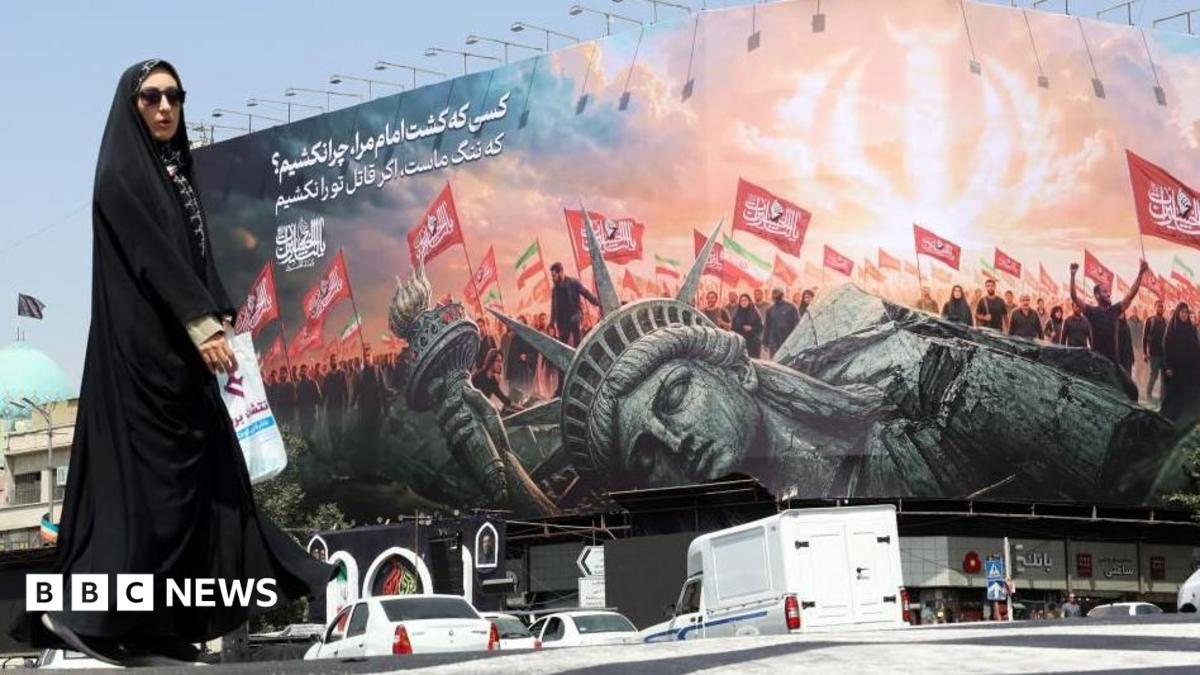
Iran says it is negotiating with Oman to reach "an understanding" over a temporary route through the Strait of Hormuz to allow commercial shipping to resume.
The statement came after US President Donald Trump said new talks on ending the war in Iran would begin on Monday - and that he had called off "massive" strikes on the country for this purpose.
Trump did not specify who would take part in the talks. Iran, however, said it was not negotiating with the US - and had no plans to do so.
Tehran's denial appears to have irked the US president, who later wrote on his Truth Social media platform that Iran's leadership was "unbelievably duplicitous".
Speaking to reporters at the White House later, he insisted talks were in fact taking place.
"They're going on right now... this is the last chance for them to sign a good document," he said.
At the weekend, Trump had said the "perimeters" of a deal had been agreed - and would include reopening Hormuz, the vital waterway whose closure by Iran has sent oil prices soaring.
Tehran has repeatedly closed off the strait since the US and Israel started attacks on the country in February.
Speaking on board Air Force One on Sunday, he said Iran "knew the extent" of the planned US strikes "because they saw it forming".
Trump declined to outline a deadline for a deal to be struck with Tehran, adding: "We'll just see how it is. We're ready to go anytime we want... I'm not looking to kill people."
Trump added that Saudi Arabia's Crown Prince Mohammed Bin Salman - as well as US partners such as the United Arab Emirates and Qatar - had urged him against conducting strikes over the weekend.
"We were all set to go," Trump said. "The reason they asked is [that] they think there's a deal," he said. "There's a deal on Hormuz, and there will be a deal on the nuclear."
Global oil prices fell on Monday morning in Asia trading after Trump's announcement. Brent Crude oil was down by 4.5% at $83.98 (£62.26), while US-traded oil was 4.6% lower at $80.74 (£59.85).
Energy prices have fluctuated since the conflict started on 28 February as traders reacted to disruptions to shipping through the Strait of Hormuz.
Around 20% of the world's crude oil and liquefied natural gas (LNG) usually flows through the strait.
Vessel-tracking data from trade intelligence company Kpler suggests commercial shipping through the strait has slowed - with 51 vessel crossings between 30 July and 2 August. This is a drop of around 28% compared to the previous 4 days, in which 71 crossings were recorded through the strait.
Talks to end the conflict - mostly facilitated by mediators - collapsed last month, ending a ceasefire agreed in April.
Trump has repeatedly vowed that a negotiated end to the war is near, only for tit-for-tat strikes to resume.
While it is unclear what negotiations may - or may not - be happening away from the public eye, Trump and the White House have often accused Iran of saying one thing privately and another publicly.
Back on 7 April, the US president warned that "a whole civilisation will die tonight" if Iran refused to engage in peace talks.
That threat did result in historic face-to-face talks in Pakistan, led by Vice-President JD Vance. However, those negotiations did not result in a deal.
The following month, he again said that he had withheld planned military operations at the behest of regional allies amid "serious negotiations", which he followed by a promise to hit Iran "very hard".
In the latter instance, he claimed that positive negotiations with Iranian leaders had prompted the operation to be called off.
At times, the White House has suggested that Iran's public statements are also aimed at a domestic audience that includes hardline members of the government and the powerful military who are opposed to making concessions to the US.
Any escalation could prove politically tricky for President Trump's Republican allies.
The Trump administration has been largely dismissive of data showing the war - and its economic impact - are broadly unpopular with Americans, including with many Republicans.
Polls showing widespread dissatisfaction with the handling of the war have prompted alarm among some conservative strategists ahead of the coming November midterms.
One poll, released by Reuters/Ipsos at the end of last week, found that only a third of Americans support the conflict, the lowest total since the war began, with the bulk of respondents pointing to unclear or shifting objectives.
With additional reporting from James Chater, Peter Hoskins, and BBC Verify's Kayleen Devlin and Becky Dale