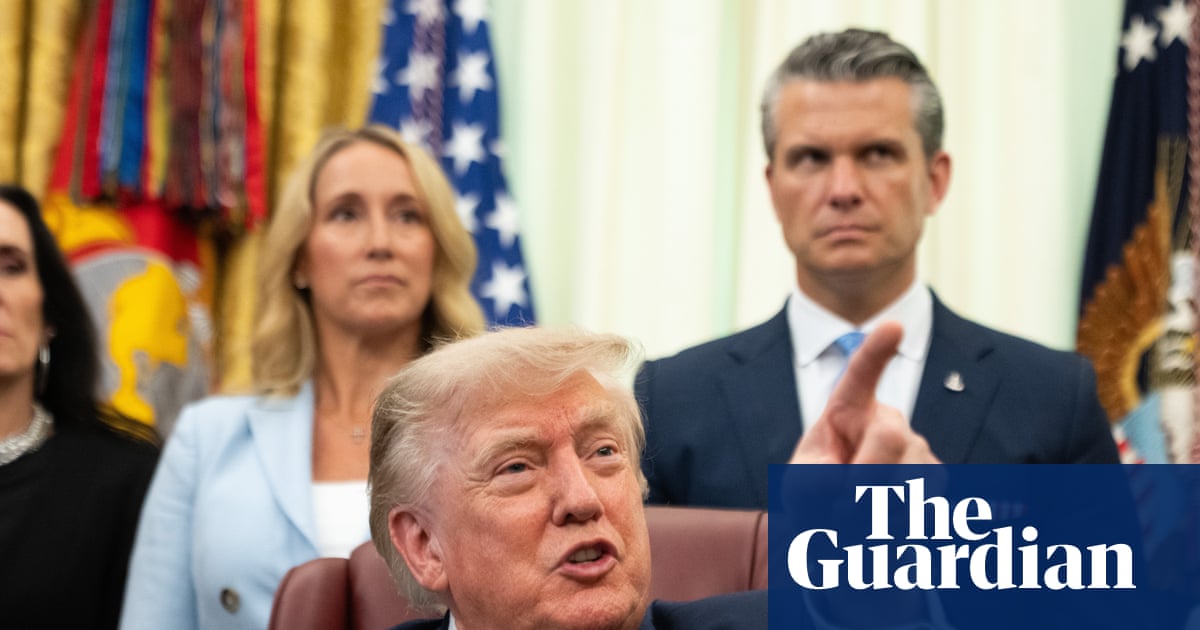
New talks between Washington and Tehran are the “last chance” for Iran to forge a deal and avoid an escalation of US strikes on the country, Donald Trump said on Monday.
Trump said he expected negotiations to begin in the next day or two to reopen the strait of Hormuz and create a pathway for Iran to address the US’s concerns about its nuclear programme.
“The first phase is the opening of the straits. The second phase will be the denuclearisation,” he told reporters in the Oval Office. “And that will take a little while.”
Trump reiterated that he was running out of patience with Iran. “This is the last chance for them to sign a good document.”
Iran has been in discussions with Oman about the creation of a temporary route through the strait that would allow commercial shipping to resume, but is not yet reviving talks with the US, Tehran’s foreign ministry spokesperson said earlier on Monday.
Esmail Baghaei denied claims by Trump that talks between the two sides covering all the major disputes between them could restart as early as Monday. “We are not currently negotiating with the United States,” he said.
Trump claimed he had held off from launching the biggest strike on any country “since world war two” over the weekend after Saudi Arabia’s crown prince, Mohammed bin Salman, rang him to urge diplomacy. Trump said the cancellation was conditional on Iran reaching a deal quickly.
It is thought to be the 12th time in the war between the US and Iran that Trump has called off threatened strikes.
On Monday, the US president called the Iranian leadership “unbelievably duplicitous” in a post on social media.
“They ask for a meeting, some would say ‘beg’, talks begin, with more scheduled in the immediate future, and they say, openly and proudly, that they’re not having any discussions, that nothing is being talked about, and they’re only dealing with ‘Oman’. They then go on to give their usual blather in saying, the Strait of Hormuz will be operated powerfully by them, when it is already completely controlled by the United States Navy and our ‘Blockade’.”
A middle route through the strait would represent progress. Iran is claiming full sovereignty over the strait and has been making demands over its routes and future management, including the possibility of charging fees in return for providing ships with maritime services.
One proposal is to create a joint Omani-Iranian company that would provide all the services that insurance companies used to provide at high costs, but at lower prices, and with preferential tariffs for some countries.
Iran’s foreign ministry spokesperson said it was discussing with Oman the possibility of an intermediate route through the strait of Hormuz to be used temporarily. Photograph: ReutersUnlocking a mutually acceptable route through the strait is the precondition to unlocking all the other agreements laid out in the memorandum of understanding, the ceasefire document both sides signed on 18 June. Disagreements about the memorandum’s obligations has led to a resumption of the war, which has spread to the Red Sea and to Iraq.
Last week, Iran’s deputy foreign minister, Kazem Gharibabadi, said Tehran was demanding that ships entering the strait take a route to the north close to Iran, but that some ships could take a southern route. Iran rejected the traffic being divided evenly between the two routes, and also that a third country could start de-mining the routes.
Baghaei told a press conference in Tehran: “We are now talking about a corridor that will have a round trip route, not two or three separate routes. This intermediate route is to be used temporarily until a decision is made on a fixed route.”
He framed the route as an alternative to the transport separation scheme, the longstanding prewar route overseen by the UN’s International Maritime Office. He said maps had been exchanged by the two sides.
Baghaedi said an agreement on a route would not solve all the problems, pointing to the continuing US naval blockade of Iran’s ports, and that unless the US approach changed, there would be no significant improvement in the situation in the strait.
Recently there had been gloom in Omani circles about reaching an agreement with Iran on routes, leading to a revival of preparations for Oman’s European allies to start to clear the southern route of mines, a step that might have provoked direct conflict between Iran and European powers.
In a sign of the pressure Tehran diplomats face, a statement from the Assembly of Experts, the body of clerics that elects the supreme leader, warned against investing any trust in the US, saying: “Hope for understanding and agreement with this bullying regime will lead nowhere.”
However, the Iranian president, Masoud Pezeshkian, said he believed the “memorandum of understanding would prove to be the centre of gravity of our foreign relations in the future”.
The Saudis’ intervention came in a week in which Riyadh attacked Iranian-backed forces inside Iraq and raised the temperature in its dispute with the Iranian-backed Houthis in northern Yemen, underlining the extent to which Saudi Arabia fears the consequence of an all-out US war against Iran spiralling out of control across the Middle East.
Additional reporting by Associated Press