Aug 5, 2026, 11:01 a.m.
3 min read
Bitcoin price (CoinDesk Data)Summary
- Bitcoin is trading little changed even as global stock indexes hit record highs on AI optimism and easing energy concerns, underscoring crypto-specific weakness.
- Derivatives data show subdued activity in bitcoin and ether but aggressive positioning in select altcoins.
- A sharp $4 billion, 60-day contraction in Tether’s market value signals capital leaving crypto and may indicate late-stage selling. A durable bottom would require USDT supply to start rising again.
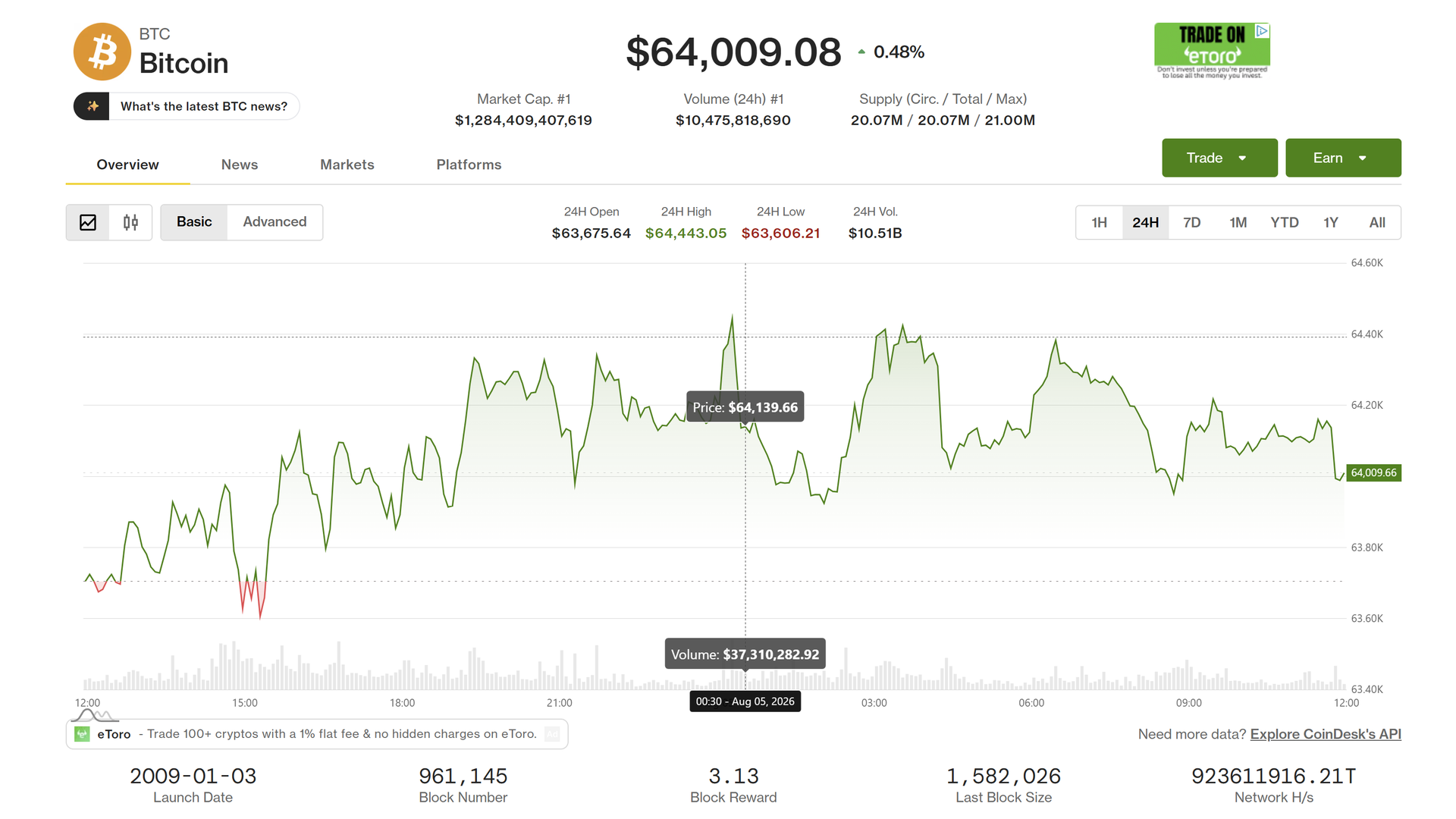
Bitcoin BTC$64,468.05 was little changed, adding 0.16% since midnight UTC to trade near $64,000, even as global equities hit new highs, fueled by optimism over AI and progress toward reopening the Strait of Hormuz, which pushed oil prices lower.
MSCI's All Country World Index rose 0.4% toward another record close, its Asia Pacific benchmark gained 2.2%, and Australian shares hit a new peak after the S&P 500 and Dow Jones Industrial Average closed at all-time highs Tuesday.
The broader CoinDesk 20 (CD20) is unchanged since midnight, with 11 components rising and nine declining.
The divergence points to crypto-specific weakness. U.S. spot bitcoin ETFs recorded $5.4 billion of net outflows in the first half of the year as capital rotated into AI-linked assets.
“Institutional and retail interest in crypto as an investment has cooled as AI absorbs a disproportionate share of capital and attention; most sectors, not just crypto, have underperformed AI over the past year,” DWF Labs wrote in a report.
Today’s direction may find a catalyst in U.S. employment figures and ISM services PMI due later.
Circle Internet (CRCL), issuer of the second-largest stablecoin (USDC), said second-quarter revenue grew 7% from the year earlier. The $701 million figure fell short of estimates, Bloomberg reported.
Galaxy Digital (GLXY) is also due to report today. Riot Platforms (RIOT) delayed its report for an unspecified period.
Derivatives Positioning
- Crypto futures sentiment: The crypto futures long/short ratio remains bearish, with shorts accounting for 51% of taker volume. That is slightly better than the recent 52/48 split in favor of the bears.
- PUMP market strength: PUMP is the best-performing top-100 token over the past 24 hours, up 115%. The price surge lit up the futures market, where open interest has increased by 9% to 84.76 billion tokens. That tally, though, is not new. We have been here recently, so while the single-day growth is impressive, the overall level of activity is nothing out of the ordinary.
- Open-interest movers: Other open-interest gainers include XLM, ZEC and BNB. Tokens seeing declines, which likely reflect capital outflows, are SHIB, HBAR and LTC. There is little action in bitcoin and ether futures.
- Aggressive buying in some altcoins: Both ZEC and BTC bulls boast positive 24-hour open-interest-adjusted cumulative volume delta, which is also the highest among majors. This suggests that traders taking long positions may be more aggressive, using market orders rather than passive limit orders. On the opposite end are XLM and DOGE.
- XLM funding rate: XLM also stands out for a notably negative annualized perpetual funding rate of -23%. That means perpetual contracts are trading at a discount to the spot price, reflecting a growing bias toward bearish positioning.
- Bitcoin volatility: Yesterday, we noted the meltdown in bitcoin’s 30-day implied, or expected, volatility index and how it was at a level from which it has tended to bounce sharply. That has not changed, and the index remains around 36%. The same is true for ether’s volatility index, EVIV.
- Options flow: In Deribit-listed options, bitcoin and ether volume rankings continue to feature call options. A call provides asymmetric upside exposure, representing a bullish bet on the market. OTC desk Paradigm featured bearish ether risk reversals.
Token Talk
- Tether's market cap has shrunk by $4 billion over 60 days, one of the steepest contractions on record, according to CryptoQuant. USDT's supply expands when new money enters crypto, since dollars get converted into the stablecoin to buy other tokens, and it shrinks when the flow reverses. A $4 billion drop means capital has been leaving the system.
- CryptoQuant frames it as near exhaustion. The firm noted that the market's deepest USDT contraction phases have historically lined up closer to points where selling pressure was running out than to the start of another leg down. On that read, a shrinking stablecoin supply this severe has tended to mark late-stage selling.
- The chart cuts both ways. Past troughs this deep, in early 2023 and mid-2026 on the same gauge, preceded bitcoin recoveries. But USDT supply contracting alongside a bitcoin that has gone sideways since May is also a plain read on demand drying up. A contraction marking a bottom holds only once the supply turns back up. It hasn't yet.
- Watch USDT's supply trend, not just its size. If the 60-day change climbs back toward zero, fresh dollars are entering and CryptoQuant's exhaustion call gets support. If it keeps sinking, the money is still leaving and the contraction has further to run.
Related Assets
- 1
- 2
- 3
- 4
- 5
- 6
- 7
- 8
- 9
- 10
The Evolution of the Crypto CEX Landscape: A Case Study on Binance
The Evolution of the Crypto CEX Landscape: A Case Study on Binance
Binance remains crypto’s leading exchange, expanding from spot and derivatives into RWAs, payments, savings, yield, and broader financial services.
Jun 29, 2026
Binance remains crypto’s leading exchange, expanding from spot and derivatives into RWAs, payments, savings, yield, and broader financial services.
Why it matters:
Binance remains crypto’s leading exchange, expanding from spot and derivatives into RWAs, payments, savings, yield, and broader financial services.
View Full Report