More than 100 artists, writers and scientists have called for the UK government to save the “world’s clearest eyes on the sky”, after funding for thenetwork of radio telescopes at Jodrell Bank Observatory was slashed.
New Order, the Canadian astronaut Chris Hadfield and the poet laureate, Simon Armitage, are among those calling on the new prime minister, Andy Burnham, to save the deep space observatory which includes the Grade I-listed Lovell telescope, prized by astronomers who study galaxies, star formation and planets beyond the solar system.
Last week the observatory’s funder, UK Research and Innovation (UKRI), said it would withdraw funding for the e-Merlin network, the UK’s national radio astronomy facility at Jodrell Bank, when the current agreement ends in March 2028.
“We believe that to shut it down to save just £2.8m a year is foolish and shortsighted,” states the letter to Burnham as well as the business secretary, Jonathan Reynolds, and the head of UKRI.
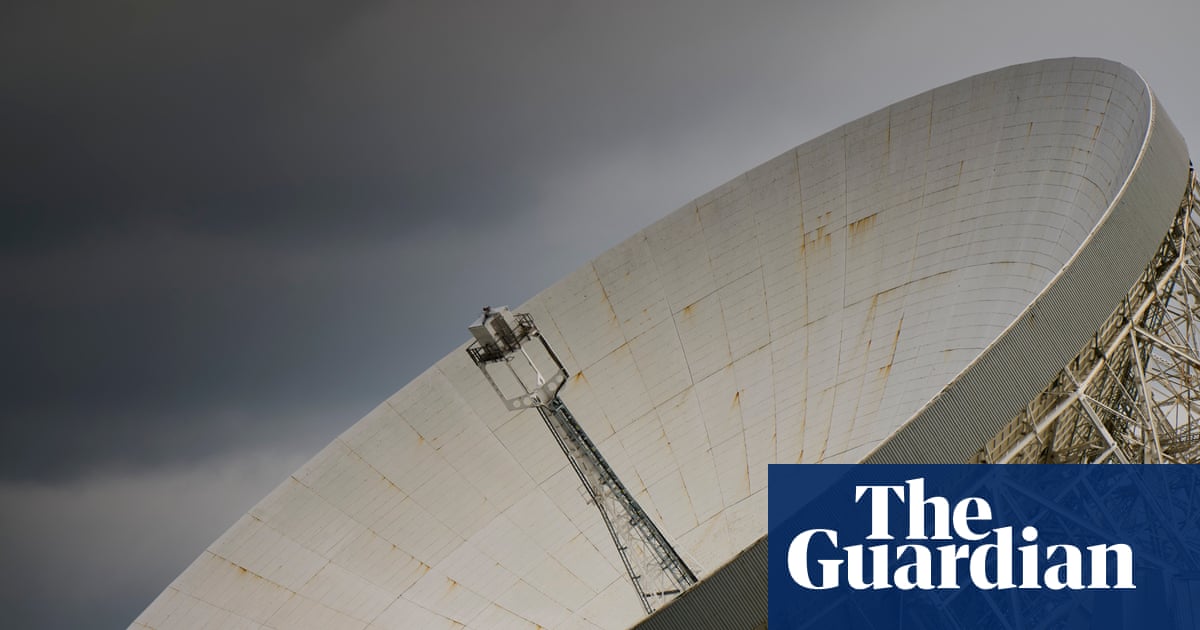
Jodrell Bank Observatory in Cheshire is facing closure after government funding for the facility was slashed. Photograph: Christopher Thomond/The GuardianThe letter argues that to close down the home of e-Merlin would be to poke out “some of the world’s clearest eyes on the sky”. The Lovell telescope tracked the Sputnik launch in 1957 and is at the centre of a global project tasked with mapping the first billion years of the universe.
Scientists have also called the decision a blow to UK astronomy, with observations at Jodrell Bank in Cheshire due to end completely unless other funding is found. The move threatens 28 jobs at the observatory and will affect nearly 3,000 researchers who work within the facility. Further cuts were announced for dozens of facilities, instruments and projects, which are expected to result in about 800 job losses.
The UKRI has an annual budget of nearly £10bn. The drop in funding is the latest in a rolling package of cuts from the Science and Technology Facilities Council (STFC), which it funds. The STFC needs to make substantial savings as a result of cost overruns, soaring electricity and staff costs, and high foreign exchange rates for international collaborations.
The letter continues: “This beacon of science is more ambitious than ever, with exciting plans already under way that will ensure the UK’s relevance and leadership in the rapidly evolving domain of science exploration and utilisation.”
It argues that continued funding of Jodrell Bank, a Unesco world heritage site and the UK’s largest radio telescope, would ensure vital contributions to global safety, including tracking space debris, destructive solar flares, satellites and asteroids.
The observatory hosts the new headquarters of the Square Kilometre Array Observatory (SKAO), a global project tasked with mapping the first billion years of the universe with sister telescopes in South Africa and Western Australia.
“Do we really want SKAO discoveries to be announced from a HQ alongside what would be the world’s largest disused radio telescope?” the letter states. “We ask that you find funding for it immediately, so that the unique and essential services it provides can continue without interruption, and so that this important source of national pride and global scientific respect is saved.”
Jodrell Bank was among dozens of facilities, instruments and projects hit by cuts last week. The Rubin Observatory in Chile, which began work only last month to capture the largest astronomical survey in history, faces a 20% cut to UK participation. Another telescope, the Next-Generation Transit Survey, which is searching for solar systems similar to Earth’s, received a 45% cut. The UK will also withdraw from the Event Horizon Telescope that allowed astronomers to image the black hole at the heart of the Milky Way.
A spokesperson for the STFC previously said the body had “undertaken a rigorous prioritisation process to focus investment on the areas that will deliver the greatest long-term scientific capability, impact and value for the UK”.